
Topographical Anatomy: Limbs and Torso
Develop precise spatial mastery of musculoskeletal structures across the extremities and trunk. Learn to map deep and superficial muscle compartments directly to clinical bony landmarks, retinacular pulleys, and aponeurotic boundaries. Perfect your structural identification skills through the diagnostic architecture of the limbs, chest, abdominal wall, and back.
Like Duolingo, but for Topographical Anatomy: Limbs and Torso. Tomo turns the whole topic into a game you play five minutes a day, until it actually sticks.
26 levels across 3 sections, about 52 minutes end to end, roughly 10 days at five minutes a day. It moves through Upper Limb and Scapular Architecture, Torso and Trunk Muscle Architecture, and Lower Limb and Foot Architecture.
Free forever · No credit card · iPhone & Android
Key ideas in Topographical Anatomy: Limbs and Torso
- Origins anchor muscles pulling toward the torso, while insertions represent mobile attachments pulling the scapula relative to the thoracic wall
- Pectoralis minor inserts onto the medial border and superior surface of the coracoid process, functioning to depress and protract the scapula
- The short head of the biceps brachii and coracobrachialis share an origin on the apex of the coracoid process via a conjoined tendon
- Pectoralis major inserts onto the lateral lip (crest of the greater tubercle)
- Latissimus dorsi inserts into the floor of the groove ('the lady between two majors')
- Teres major inserts onto the medial lip (crest of the lesser tubercle)
- The deltopectoral triangle is bounded superiorly by the clavicle, medially by the clavicular head of pectoralis major, and laterally by the anterior border of the deltoid
- The cephalic vein travels superiorly along the deltopectoral groove into the triangle before piercing the clavipectoral fascia to drain into the axillary vein
- The basilic vein courses along the medial arm and pierces the brachial fascia much more distally to form or join the axillary vein
- The radial groove obliquely separates the lateral head of triceps brachii (which originates superior and lateral to the groove) from the medial head (which originates inferior and medial to the groove across a broad surface)
- The radial nerve and deep brachial artery (profunda brachii) run in direct apposition to the periosteum within the radial groove
- Mid-shaft humeral fractures commonly injure the radial nerve in this groove, resulting in wrist drop due to denervation of forearm extensors while sparing triceps long head function
- Brachialis originates from the distal anterior humerus and inserts onto the tuberosity and coronoid process of the ulna
- Because the ulna does not rotate during pronation or supination (the radius rotates around a stationary ulna), brachialis remains an equally powerful flexor in all forearm positions
- Biceps brachii inserts onto the radial tuberosity, which rotates posteriorly in full pronation, putting the tendon on slack and mechanical disadvantage for flexion
- The pronator teres arises from the medial epicondyle and the coronoid process, running obliquely downward and laterally to insert on the mid-shaft of the radius.
You've tried the other tabs
Thirty open tabs. Four facts you actually kept.
You watched. You nodded. By Sunday it was gone.
One answer, then back to scrolling.
Eight weeks. You meant to finish. You didn't.
Tomo gives Topographical Anatomy: Limbs and Torso the Duolingo treatment: levels, streaks, and quick quizzes that test what you just learned. That game loop is what the tabs above never had, so it's the one you actually finish.
Here's what playing it feels like
A real question from this course. Take your best guess.
Where does pectoralis minor attach to the coracoid process to pull your shoulder blade down and forward?
Get it right to open this lesson and 25 more in the app.
Where Topographical Anatomy: Limbs and Torso takes you
- 1
Upper Limb and Scapular Architecture
- Pectoral Girdle and Brachial Compartments
- Antebrachial Compartments and Retinacular Systems
- 2
Torso and Trunk Muscle Architecture
- Anterior Torso and Abdominal Wall Planes
- The Upper Back and Scapulothoracic Interface
- 3
Lower Limb and Foot Architecture
- Bony Landmarks of the Knee, Tibia, and Fibula
- Crural Compartments of the Leg
- Retinacular Anchors and the Four Plantar Layers
3 sections · 7 units · 26 levels. Built to play, not to enroll.
Tomo is in ChatGPT
Tomo is also a ChatGPT plugin: the same playable courses, built and played inside your chat.
Add Tomo to ChatGPT- What to ask
- “Make me a Tomo course on black holes.” “Turn this chat into a Tomo course.”
- What you get
- Quick questions with instant feedback, hearts and stars, ready to play in about a minute.
- Where it goes
- No sign-up to start. Connect your Tomo account and your streak carries on in the app.
You pick the voice
Topographical Anatomy: Limbs and Torso is taught in the Bestie style: your friend who just gets it. Want a different feel? In the app you can spin up the same topic in any of Tomo's teaching styles. Same facts, totally different vibe.
More Science on Tomo
Human Anatomy: Bones and Muscle
Move beyond memorizing muscle and bone names to understand how the human musculoskeletal system functions as an integrated mechanical machine. Learn how joints dictate movement, why muscles operate in coupled pairs, and how living tissue remodels under load.
Muscle Attachments and Vector Mechanics
An advanced exploration of musculoskeletal biomechanics focusing on how origins, insertions, and lines of pull dictate human movement. Move beyond rote memorization to analyze dynamic moment arms, action inversions across joint angles, and closed-chain force transmission.
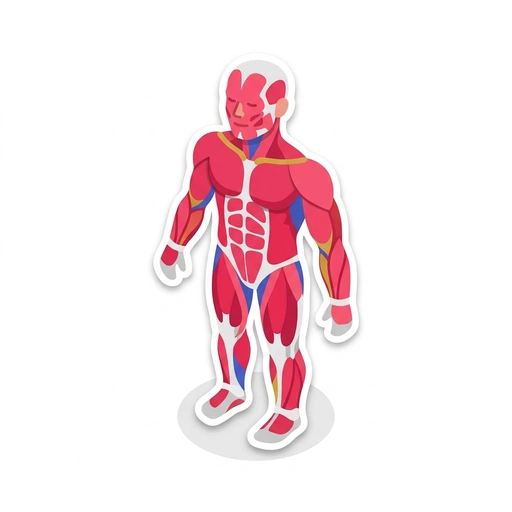
Human Muscle Anatomy
Discover how facial expressions, posture, and athletic movements actually work from the inside out. Learn the major muscle groups of the human body and the physiological mechanics behind every motion.
Decoding Human Muscle Names
Stop memorizing muscle names as arbitrary Latin jargon. Discover the simple visual code of shapes, sizes, and attachment points that makes anatomical names instantly make sense.
Anatomy: Bones, Muscles, and Nerves
Bridge the gap between memorizing isolated terms and understanding the human body as an integrated machine. Master skeletal landmarks, muscle attachment logic, and peripheral nerve pathways.

Reading Human Anatomy
Move beyond isolated muscle names to understand how the body organizes space, transfers force, and routes vital plumbing. Learn to navigate the living blueprint using landmarks, compartments, and kinetic chains.
Start Topographical Anatomy: Limbs and Torso today.
Download Tomo, search Topographical Anatomy: Limbs and Torso, and play your first lesson in under a minute.