
Reading Human Anatomy
Move beyond isolated muscle names to understand how the body organizes space, transfers force, and routes vital plumbing. Learn to navigate the living blueprint using landmarks, compartments, and kinetic chains.
Like Duolingo, but for Reading Human Anatomy. Tomo turns the whole topic into a game you play five minutes a day, until it actually sticks.
A short one: 11 levels across 2 sections, about 22 minutes end to end, roughly 4 days at five minutes a day. It moves through The Surface and Movement Blueprint and Internal Highways and Compartments. It assumes you already know the basics.
Free forever · No credit card · iPhone & Android
Key ideas in Reading Human Anatomy
- The ASIS provides a subcutaneous pelvic anchor to evaluate leg length and pelvic tilt.
- The prominent C7 spinous process marks the stable transition between cervical and thoracic spine.
- The clavicle forms an unyielding boundary separating the root of the neck from the axilla.
- Contracting muscle bellies bulge, shorten, and shift relative to overlying skin.
- Tendon attachments provide immovably anchored reference lines directly onto skeletal bone.
- The long head of the biceps tendon reliably tracks inside the bicipital groove during rotation.
- The cubital fossa channels the brachial artery and median nerve just deep to thin fascia.
- The anatomical snuffbox contains the radial artery winding over the carpal bones.
- The popliteal fossa shelters the popliteal artery and tibial nerve behind the knee joint.
- Intermuscular fascial septa anchor deeply to bone to wall off functional muscle groups.
- The lateral intermuscular septum of the thigh divides the quadriceps from the hamstrings.
- Palpable fascial grooves distinguish antagonistic muscle compartments with opposing actions.
- High articular congruence means mating bone surfaces fit together closely, providing passive stability.
- A deep bony socket naturally limits extreme range of motion while resisting shearing forces.
- Shallow sockets like the glenoid fossa sacrifice bony congruence to permit multi-planar mobility.
- A biarticular muscle crosses two separate joint axes and exerts torque on both simultaneously.
You've tried the other tabs
Thirty open tabs. Four facts you actually kept.
You watched. You nodded. By Sunday it was gone.
One answer, then back to scrolling.
Eight weeks. You meant to finish. You didn't.
Tomo gives Reading Human Anatomy the Duolingo treatment: levels, streaks, and quick quizzes that test what you just learned. That game loop is what the tabs above never had, so it's the one you actually finish.
Here's what playing it feels like
A real question from this course. Take your best guess.
When you slide your finger down the back of the neck, what does the prominent bump at C7 mark?
Get it right to open this lesson and 10 more in the app.
How to learn Reading Human Anatomy, step by step
Go in order. 11 short levels across 2 sections, about 22 minutes in all, five minutes a day.
- 1
The Surface and Movement Blueprint
- Mapping Surface Landmarks
- Joint Architecture and Kinetic Chains
- 2
Internal Highways and Compartments
- Tracing Neurovascular Pathways
- Compartments and Visceral Packing
2 sections · 4 units · 11 levels. Built to play, not to enroll.
Questions about Reading Human Anatomy
How do I learn Reading Human Anatomy?
Go in order: start with The Surface and Movement Blueprint, then Internal Highways and Compartments. On Tomo that's 11 short levels, about 22 minutes in all, played five minutes a day. Start free and play the first level in under a minute.
Is there a Duolingo-style app for Reading Human Anatomy?
Yes. Tomo works like Duolingo: short daily lessons, streaks and quick quizzes. Reading Human Anatomy is one of its free courses, and you can type any other topic to get a course of your own.
Is the Reading Human Anatomy course free?
Yes. Reading Human Anatomy is playable on Tomo's free plan, which doesn't expire. No credit card, no waitlist. Download the app and start your first lesson.
How long does it take to learn Reading Human Anatomy?
11 levels across 2 sections, about 22 minutes of play in total. It's built for five minutes a day, so you finish it a little at a time instead of all at once.
Do I need any background to start Reading Human Anatomy?
No. It's pitched at an intermediate level, so it starts where you are and builds up. If you can tap a phone, you can start.
Tomo is in ChatGPT
Tomo is also a ChatGPT plugin: the same playable courses, built and played inside your chat.
Add Tomo to ChatGPT- What to ask
- “Make me a Tomo course on black holes.” “Turn this chat into a Tomo course.”
- What you get
- Quick questions with instant feedback, hearts and stars, ready to play in about a minute.
- Where it goes
- No sign-up to start. Connect your Tomo account and your streak carries on in the app.
You pick the voice
Reading Human Anatomy is taught in the Bestie style: your friend who just gets it. Want a different feel? In the app you can spin up the same topic in any of Tomo's teaching styles. Same facts, totally different vibe.
More Science on Tomo
Applied Human Anatomy
Bridge the gap between textbook organ lists and real human function. Learn how fascial planes, neurovascular pathways, and visceral architecture shape the living body.
Human Anatomy: Form and Function
Bridge the gap between basic body parts and true functional anatomy. Discover how bones, muscles, nerves, and organs mechanically coordinate to sustain motion, regulate pressure, and maintain life.
How the Human Body Fits Together
Move beyond memorizing isolated bones and organs to understand how your body is engineered. Learn the mechanical tradeoffs, vascular highways, and pressure chambers that keep everything working.
Functional Human Anatomy
Understand how the human body operates as an integrated mechanical and physiological system. Explore joint levers, vascular pressure gradients, organ compartmentalization, and deep neural wiring.
Anatomy: Bones, Muscles, and Nerves
Bridge the gap between memorizing isolated terms and understanding the human body as an integrated machine. Master skeletal landmarks, muscle attachment logic, and peripheral nerve pathways.
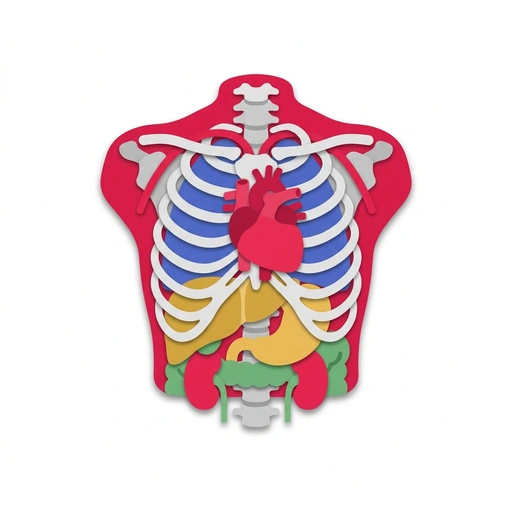
The Architecture of the Human Body
Understand how the human body really fits together, from bony landmarks and force-transmitting joints to visceral compartments and neurovascular routes.
Start Reading Human Anatomy today.
Download Tomo, search Reading Human Anatomy, and play your first lesson in under a minute.