
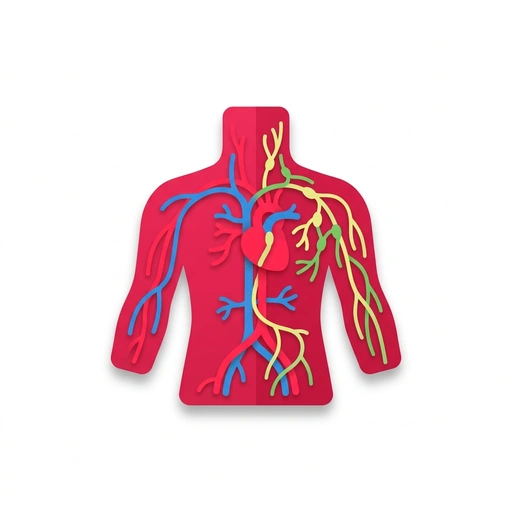
Vascular and Lymphatic Anatomy
دليل تشريح الأوعية الدموية والجهاز الليمفاوي لطلاب الكليات الطبية بأسلوب مصري مبسط. يركز على الفهم العميق، مسارات الشرايين والأوردة، وتوزيع العقد الليمفاوية، مع التركيز على أهم التكات الإكلينيكية وأسئلة الامتحانات الشائعة.
Like Duolingo, but for Vascular and Lymphatic Anatomy. Tomo turns the whole topic into a game you play five minutes a day, until it actually sticks.
A deep dive: 43 levels across 5 sections, about 86 minutes end to end, roughly 17 days at five minutes a day. It moves through The Core Circulatory Circuit and Vessel Design, Systemic Arteries and Exam Landmarks, Venous Return and Portal Networks, Lymphatic Drainage and Immune Geography, and Clinical Anatomy and High-Yield Exam Vignettes. It starts from scratch.
Free forever · No credit card · iPhone & Android

Key ideas in Vascular and Lymphatic Anatomy
- الدورة الرئوية هدفها الأساسي تمرير الدم على الرئتين لتبادل الغازات والتخلص من الفضلات
- الدورة الجهازية مسؤولة عن نقل الدم المحمل بالأكسجين والمغذيات للأطراف والمخ وكل الأجهزة الحيوية
- البطين الأيسر بيضخ الدم في الشريان الأورطي (Aorta) بضغط عالي ليوصل لأبعد نقطة في الجسم
- البطين الأيمن بيضخ الدم فقط للرئتين عبر الشريان الرئوي، والرئتين جنبه مباشرة فمش محتاج ضغط عالي
- تعريف الشريان الثابت تشريحياً هو أي وعاء دموي خارج من القلب وواخد الدم بعيد عنه
- الشريان الرئوي خارج من القلب واخد دم غير مؤكسج رايح بيه للرئة، ورغم كده اسمه شريان
- الأوردة والأوعية الليمفاوية شغالة بنظام ضغط واطي ومفيهاش نبض وضخ قوي زي الشرايين
- الصمامات (Valves) بتمنع الدم والليمف من الرجوع للخلف بفعل الجاذبية
- انقباض العضلات الهيكلية بيضغط على الأوعية ويرفع السوائل باتجاه القلب
- الطبقة الداخلية الملامسة للدم مباشرة هي Tunica intima ومبطنة بخلايا endothelium ناعمة
- الطبقة الوسطى Tunica media بتتكون من ألياف عضلية ومرنة بتتحكم في قطر الوعاء
- الطبقة الخارجية Tunica externa أو adventitia نسيج ضام بيحمي الوعاء ويثبته في مكانه
- الشرايين الكبيرة زي الأورطي بتتمدد وقت انقباض القلب لامتصاص صدمة ضغط الدم العالي
- الجدران المرنة بترتد لوضعها الطبيعي وقت الانبساط وتضغط على الدم لتكملة حركته للأمام
- الـ Arterioles بتحتوي على نسبة عضلات ملساء عالية وتعتبر محابس التحكم الأساسية في المقاومة الطرفية (Total Peripheral Resistance)
- تضييق هذه الشريينات بيزود المقاومة ويرفع ضغط الدم الشرياني العام فوراً
You've tried the other tabs
Thirty open tabs. Four facts you actually kept.
You watched. You nodded. By Sunday it was gone.
One answer, then back to scrolling.
Eight weeks. You meant to finish. You didn't.
Tomo gives Vascular and Lymphatic Anatomy the Duolingo treatment: levels, streaks, and quick quizzes that test what you just learned. That game loop is what the tabs above never had, so it's the one you actually finish.
Here's what playing it feels like
A real question from this course. Take your best guess.
إيه المهمة الأساسية للدورة الجهازية (Systemic) في جسمك؟
Get it right to open this lesson and 42 more in the app.
How to learn Vascular and Lymphatic Anatomy, step by step
Go in order. 43 short levels across 5 sections, about 1 hour 26 minutes in all, five minutes a day.
- 1
The Core Circulatory Circuit and Vessel Design
- The Big Picture: Pulmonary vs Systemic Circuits
- Vessel Architecture: Layers and Capillaries
- 2
Systemic Arteries and Exam Landmarks
- The Aorta and Head/Neck Arteries
- Abdominal Aorta and Visceral Supply
- Arterial Supply to Upper and Lower Limbs
- 3
Venous Return and Portal Networks
- Systemic Venous Return: Cava Systems and Deep Veins
- The Hepatic Portal System and Shunts
- Specialized Venous Networks: Cranial and Trunk
- 4
Lymphatic Drainage and Immune Geography
- The Drainage Plumbing: Capillaries and Major Ducts
- Lymph Node Stations and Regional Drainage
- Lymphoid Organs: Spleen, Thymus, and MALT
- 5
Clinical Anatomy and High-Yield Exam Vignettes
- Vascular Pathoanatomy: Aneurysms and Ischemia
- Lymphatic Pathology and Metastasis Exam Patterns
5 sections · 13 units · 43 levels. Built to play, not to enroll.
Questions about Vascular and Lymphatic Anatomy
How do I learn Vascular and Lymphatic Anatomy?
Go in order: start with The Core Circulatory Circuit and Vessel Design, then Systemic Arteries and Exam Landmarks, then Venous Return and Portal Networks, then Lymphatic Drainage and Immune Geography, and 1 more section after that. On Tomo that's 43 short levels, about 1 hour 26 minutes in all, played five minutes a day. Start free and play the first level in under a minute.
Is there a Duolingo-style app for Vascular and Lymphatic Anatomy?
Yes. Tomo works like Duolingo: short daily lessons, streaks and quick quizzes. Vascular and Lymphatic Anatomy is one of its free courses, and you can type any other topic to get a course of your own.
Is the Vascular and Lymphatic Anatomy course free?
Yes. Vascular and Lymphatic Anatomy is playable on Tomo's free plan, which doesn't expire. No credit card, no waitlist. Download the app and start your first lesson.
How long does it take to learn Vascular and Lymphatic Anatomy?
43 levels across 5 sections, about 1 hour 26 minutes of play in total. It's built for five minutes a day, so you finish it a little at a time instead of all at once.
Do I need any background to start Vascular and Lymphatic Anatomy?
No. It's pitched at a beginner level, so it starts where you are and builds up. If you can tap a phone, you can start.
Tomo is in ChatGPT
Tomo is also a ChatGPT plugin: the same playable courses, built and played inside your chat.
Add Tomo to ChatGPT- What to ask
- “Make me a Tomo course on black holes.” “Turn this chat into a Tomo course.”
- What you get
- Quick questions with instant feedback, hearts and stars, ready to play in about a minute.
- Where it goes
- No sign-up to start. Connect your Tomo account and your streak carries on in the app.
You pick the voice
Vascular and Lymphatic Anatomy is taught in the Bestie style: your friend who just gets it. Want a different feel? In the app you can spin up the same topic in any of Tomo's teaching styles. Same facts, totally different vibe.
More Health on Tomo

Human Anatomy for Nursing Practice
Master the anatomical structures, spatial relationships, and physiological landmarks most frequently tested on nursing exams and licensing boards. Bridge structural blueprints directly to clinical assessments, auscultation zones, and common nursing interventions.
The Logic of Human Anatomy
Bridge the gap between memorizing body parts and understanding how the human body actually works together. Explore surface palpation, fascial compartments, joint biomechanics, and the structural highways that keep organs and nerves functioning in harmony.
Surgical Anatomy for Plastic Surgery
Understand the structural layers, tissue planes, and vascular territories of the human body. Learn the anatomical landmarks and danger zones that guide reconstructive and aesthetic procedures.
Human Anatomy for Nursing
Learn to read the human body through the eyes of a bedside clinician. Connect structural landmarks, vital organ positions, and anatomical pathways directly to daily patient assessment.

Mapping the Human Body
Learn the precise names and locations of your body's major structures, from everyday outer landmarks to subtle joints and core internal organs. Build the vocabulary you need to describe how your body moves, feels, and hurts with clarity and confidence.
Surgical Anatomy and Tissue Reconstruction
Examine the structural planes, vascular territories, and tissue mechanics behind plastic and reconstructive surgery. Learn to identify critical anatomical landmarks and evaluate complex reconstructive procedures with precision.
Start Vascular and Lymphatic Anatomy today.
Download Tomo, search Vascular and Lymphatic Anatomy, and play your first lesson in under a minute.