
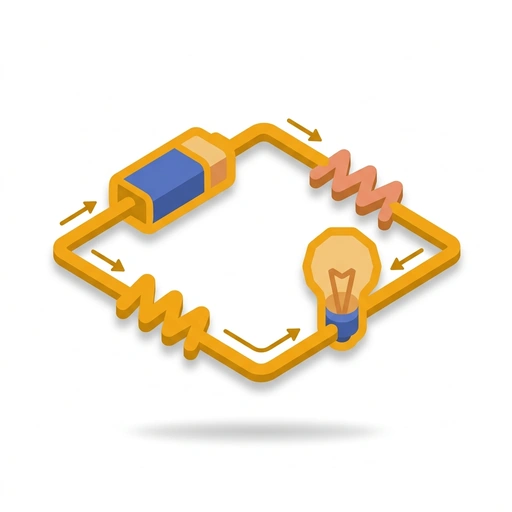
Everyday Circuit Fundamentals
Like Duolingo, but for Everyday Circuit Fundamentals. Tomo turns the whole topic into a game you play five minutes a day, until it actually sticks.
For the part of you with thirty open tabs that never became anything.
24 levels across 4 sections, about 48 minutes end to end, roughly 10 days at five minutes a day. It moves through The Moving Picture of Electricity, Balancing Flow with Ohm's Law, Arranging the Paths, and Practical Circuit Skills. It starts from scratch.
Free forever · No credit card · iPhone & Android

Key ideas in Everyday Circuit Fundamentals
- Voltage acts as the electrical pump providing pressure to push charges
- Voltage can exist across terminals even when no current is actually moving
- Voltage is the force causing the motion, not the moving charges themselves
- Current measures how much charge flows per second
- Current corresponds to the rate of water flow (gallons per minute) in a pipe
- A resistor acts like a narrow or obstructed pipe that slows down flow
- Higher resistance drops the flow rate for a given pressure
- Batteries act as the pressure source and moving charges act as the fluid
- Charges must have a complete closed loop back to the source to move
- A break anywhere in the loop stops current through the entire pathway
- Static electricity is a stationary buildup of charge with no continuous supply
- Powering electrical devices requires a sustained, circulating flow of current from a source
- A static shock equalizes stored pressure instantly rather than maintaining flow
- Current requires an unbroken circular path to move anywhere in a circuit
- Charges cannot spill out or pile up at an open break
- A break anywhere in a series path halts current instantly across the entire path
You've tried the other tabs
Thirty open tabs. Four facts you actually kept.
You watched. You nodded. By Sunday it was gone.
One answer, then back to scrolling.
Eight weeks. You meant to finish. You didn't.
Tomo gives Everyday Circuit Fundamentals the Duolingo treatment: levels, streaks, and quick quizzes that test what you just learned. That game loop is what the tabs above never had, so it's the one you actually finish.
Here's what playing it feels like
A real question from this course. Take your best guess.
In a water pipe model of an electric circuit, what acts like the water pump?
Get it right to open this lesson and 23 more in the app.
Where Everyday Circuit Fundamentals takes you
Understand how electricity actually moves, how Ohm's law shapes every circuit, and how to wire, test, and troubleshoot basic electronics with intuitive mental models.
- 1
The Moving Picture of Electricity
- The Water-Pipe Model of Electricity
- Closing the Loop and Directing Flow
- 2
Balancing Flow with Ohm's Law
- Balancing Pressure, Flow, and Bottlenecks
- Heat, Power, and Staying Safe
- 3
Arranging the Paths
- Series and Parallel Routes
- Splitting Voltages with Dividers
- 4
Practical Circuit Skills
- Measuring with a Multimeter
- Working with Diodes and Capacitors
4 sections · 8 units · 24 levels. Built to play, not to enroll.
You pick the voice
Everyday Circuit Fundamentals is taught in the The Professor style: clear, structured, thorough. Want a different feel? In the app you can spin up the same topic in any of Tomo's teaching styles. Same facts, totally different vibe.
More Technology on Tomo
Electric Circuits: Follow the Flow
Learn to trace, build, and troubleshoot the invisible paths that power our world, from simple flashlights to home wiring.

The Flow of Power: Basic Circuits
Stop guessing and start building. Learn to direct the invisible force of electricity to power lights, motors, and your own inventions.
Mastering the Flow: Practical Electronics
Move beyond simple batteries and bulbs to design circuits that solve real problems. Master the math of power, troubleshoot like a pro, and understand how modern gadgets actually think.
Ohm's Law in Circuit Design
Bridge the gap between textbook formulas and reliable hardware. Learn how professional engineers apply Ohm's law to size real loads, account for parasitic resistance, troubleshoot ground drops, and manage thermal limits.

How Electronics and Sensors Work
Discover how tiny electrical currents are tamed to measure the physical world. Build an intuitive mental model of circuits, sensors, and the quantum physics powering modern silicon chips.
The Flow of Power
Stop guessing and start building. Learn to see electricity as a flowing current you can direct, control, and use to bring your own gadgets to life.
Start Everyday Circuit Fundamentals today.
Download Tomo, search Everyday Circuit Fundamentals, and play your first lesson in under a minute.