
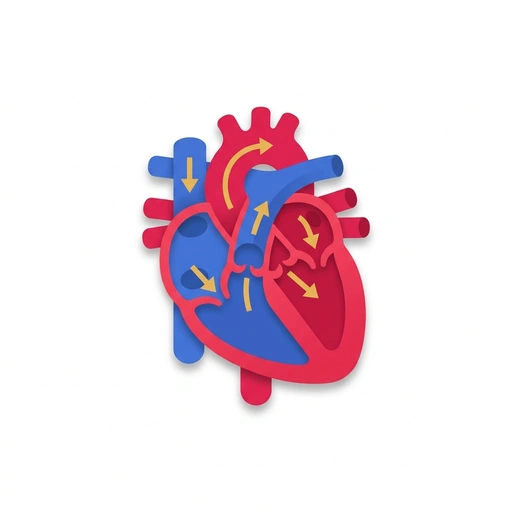
Heart Anatomy and Physiology
Build a rigorous, exam-ready mental model of how the human heart pumps, conducts, and regulates blood. Master the full circuit of blood flow, electrical pacemaking, cardiac output formulas, and clinical perfusion assessments.
Like Duolingo, but for Heart Anatomy and Physiology. Tomo turns the whole topic into a game you play five minutes a day, until it actually sticks.
22 levels across 4 sections, about 44 minutes end to end, roughly 9 days at five minutes a day. It moves through Tracing the Flow and Architecture, Rhythm and the Mechanical Beat, Hemodynamics and Bedside Evaluation, and Autonomic Control and Systemic Balance. It starts from scratch.
Free forever · No credit card · iPhone & Android

Key ideas in Heart Anatomy and Physiology
- The heart acts as two coordinated pumps operating side by side at the same time
- Both ventricles contract together, sending one stream of blood to the lungs while simultaneously sending another to the rest of the body
- Used, oxygen-poor blood from the body returns through large veins (the venae cavae)
- The right atrium is the receiving chamber that collects this oxygen-poor blood before it heads to the lungs
- Freshly oxygenated blood returns from the lungs into the left atrium and passes into the left ventricle
- The left ventricle must generate high pressure to pump this oxygen-rich blood throughout the entire body
- Heart valves are passive, mechanical flaps that swing open and shut in direct response to pressure differences
- When pressure downstream becomes higher than pressure upstream, the blood pushes the valve flaps closed to prevent backward flow
- Blood leaves the right ventricle through the pulmonary valve to pick up oxygen in the lungs
- Oxygen-rich blood returns from the lungs to the left atrium, moves into the left ventricle, and is pumped out through the aorta
- The myocardium is the middle layer made of muscle fibers that do the actual squeezing
- The endocardium lines the inside of the chambers so blood glides smoothly without catching or clotting
- The epicardium forms the heart's slick outer surface
- The right ventricle only pumps blood a short distance into the low-pressure lungs
- The left ventricle must force blood throughout the entire rest of the body through high-resistance systemic vessels
- Both ventricles pump the exact same volume of blood per beat, but the left needs far more muscle force to do it
You've tried the other tabs
Thirty open tabs. Four facts you actually kept.
You watched. You nodded. By Sunday it was gone.
One answer, then back to scrolling.
Eight weeks. You meant to finish. You didn't.
Tomo gives Heart Anatomy and Physiology the Duolingo treatment: levels, streaks, and quick quizzes that test what you just learned. That game loop is what the tabs above never had, so it's the one you actually finish.
Here's what playing it feels like
A real question from this course. Take your best guess.
When the heart's lower chambers squeeze, what happens to the blood?
Get it right to open this lesson and 21 more in the app.
How to learn Heart Anatomy and Physiology, step by step
Go in order. 22 short levels across 4 sections, about 44 minutes in all, five minutes a day.
- 1
Tracing the Flow and Architecture
- Tracing the Path of Blood
- Chamber Architecture and Heart Wall Anatomy
- 2
Rhythm and the Mechanical Beat
- The Electrical Conduction Network
- The Cardiac Cycle and Heart Sounds
- 3
Hemodynamics and Bedside Evaluation
- Calculating Stroke Volume and Cardiac Output
- Capillary Refill Time and Peripheral Perfusion
- 4
Autonomic Control and Systemic Balance
- Autonomic Regulation and Pressure Homeostasis
4 sections · 7 units · 22 levels. Built to play, not to enroll.
Questions about Heart Anatomy and Physiology
How do I learn Heart Anatomy and Physiology?
Go in order: start with Tracing the Flow and Architecture, then Rhythm and the Mechanical Beat, then Hemodynamics and Bedside Evaluation, then Autonomic Control and Systemic Balance. On Tomo that's 22 short levels, about 44 minutes in all, played five minutes a day. Start free and play the first level in under a minute.
Is there a Duolingo-style app for Heart Anatomy and Physiology?
Yes. Tomo works like Duolingo: short daily lessons, streaks and quick quizzes. Heart Anatomy and Physiology is one of its free courses, and you can type any other topic to get a course of your own.
Is the Heart Anatomy and Physiology course free?
Yes. Heart Anatomy and Physiology is playable on Tomo's free plan, which doesn't expire. No credit card, no waitlist. Download the app and start your first lesson.
How long does it take to learn Heart Anatomy and Physiology?
22 levels across 4 sections, about 44 minutes of play in total. It's built for five minutes a day, so you finish it a little at a time instead of all at once.
Do I need any background to start Heart Anatomy and Physiology?
No. It's pitched at a beginner level, so it starts where you are and builds up. If you can tap a phone, you can start.
Tomo is in ChatGPT
Tomo is also a ChatGPT plugin: the same playable courses, built and played inside your chat.
Add Tomo to ChatGPT- What to ask
- “Make me a Tomo course on black holes.” “Turn this chat into a Tomo course.”
- What you get
- Quick questions with instant feedback, hearts and stars, ready to play in about a minute.
- Where it goes
- No sign-up to start. Connect your Tomo account and your streak carries on in the app.
You pick the voice
Heart Anatomy and Physiology is taught in the Explain Like I'm 5 style: no big words. promise.. Want a different feel? In the app you can spin up the same topic in any of Tomo's teaching styles. Same facts, totally different vibe.
More Health on Tomo
Cardiovascular Physiology for Nursing Practice
Bridge structural anatomy, cellular electrophysiology, and hemodynamics directly to clinical nursing assessment. Master the mechanics of cardiac output, valve dynamics, and rhythm strip translation to anticipate bedside complications and interpret vital sign trends with diagnostic confidence.
Functional Anatomy of the Heart
Move beyond basic chambers and diagrams to understand how cardiac architecture drives pressure, flow, and electrical signaling. Learn to connect valve structure to heart sounds, ventricular geometry to pumping mechanics, and coronary maps to ischemia risks.
Clinical Anatomy and Physiology
Bridge foundational human biology and medical practice. Connect gross anatomical architecture and systemic physiology directly to bedside physical diagnosis and clinical signs.
Anatomy and Physiology for Nursing
Build a working understanding of the human body and how its organ systems cooperate to keep us alive. Tailored for nursing entrance exams like the TEAS and HESI, this course covers high-yield anatomy, physiological feedback loops, and cellular mechanisms.
Anatomy and Physiology for Patient Care
Learn the physiological mechanics behind human vital signs, fluid balance, and organ systems. Connect physical bedside cues directly to internal biology so you understand what the body is doing and why. Designed specifically to build practical physiological intuition for clinical care.
Advanced Pathophysiology for Ontario PCPs
A mastery-level exploration of the physiological breakdowns in respiratory, cardiac, and neurological systems, tailored for the Ontario Primary Care Paramedic scope.
Start Heart Anatomy and Physiology today.
Download Tomo, search Heart Anatomy and Physiology, and play your first lesson in under a minute.