
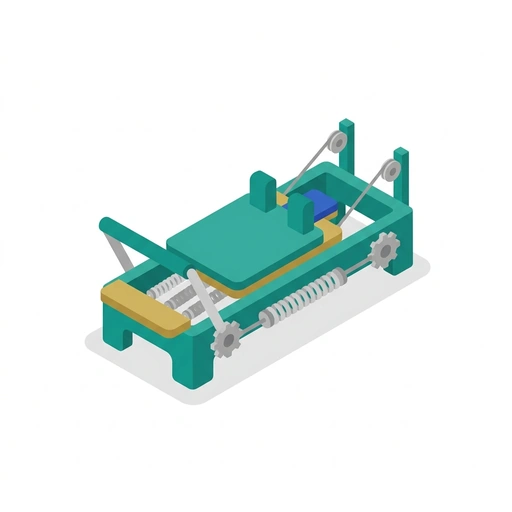
How the Pilates Reformer Works
Like Duolingo, but for How the Pilates Reformer Works. Tomo turns the whole topic into a game you play five minutes a day, until it actually sticks.
For the part of you with thirty open tabs that never became anything.
20 levels across 3 sections, about 40 minutes end to end, roughly 8 days at five minutes a day. It moves through The Moving Foundation; Levers and Direct Contact Points; and Customization, Add-Ons, and Care. It starts from scratch.
Free forever · No credit card · iPhone & Android

Key ideas in How the Pilates Reformer Works
- The carriage glides on wheels along stationary metal frame rails rather than staying fixed
- Bodyweight moves dynamically with the carriage instead of being supported by a solid floor
- Muscles must continuously stabilize to control the carriage's movement
- Shoulder blocks brace the tops of the shoulders so the body does not slide backward during leg presses
- Feeling equal contact against both shoulder blocks tells the mover their torso is centered and square on the carriage
- A raised headrest supports a neutral neck when lying flat with hips down
- Lifting the hips into a bridge with a raised headrest forces the cervical spine into excessive flexion, crunching the neck under bodyweight
- The headrest must lay flat whenever the pelvis lifts above the shoulders
- Hands must always anchor onto a stationary part of the frame or footbar first
- The first foot must plant onto the non-moving standing platform for stability
- The second foot steps onto the gliding carriage only after weight is securely grounded
- Reformer springs stretch as the carriage moves further away from the stopper
- Spring resistance grows progressively heavier the more it extends, unlike static dumbbell weight
- Heavy springs provide a supportive floor that helps hold body weight up
- Lighter springs offer little carriage support, forcing the core to work harder to prevent the carriage from drifting
- The safe sequence for stepping onto a reformer for standing work
You've tried the other tabs
Thirty open tabs. Four facts you actually kept.
You watched. You nodded. By Sunday it was gone.
One answer, then back to scrolling.
Eight weeks. You meant to finish. You didn't.
Tomo gives How the Pilates Reformer Works the Duolingo treatment: levels, streaks, and quick quizzes that test what you just learned. That game loop is what the tabs above never had, so it's the one you actually finish.
Here's what playing it feels like
A real question from this course. Take your best guess.
When you exercise on a reformer, how is your bodyweight supported differently than on a floor mat?
Get it right to open this lesson and 19 more in the app.
Where How the Pilates Reformer Works takes you
Demystify the springs, carriage, ropes, and bars of the most versatile Pilates apparatus. Learn how each component functions, how to adjust the machine for your body, and how to practice safely.
- 1
The Moving Foundation
- The Carriage and Frame
- Springs and Progressive Resistance
- 2
Levers and Direct Contact Points
- The Footbar System
- Ropes, Straps, and Pulleys
- 3
Customization, Add-Ons, and Care
- Boxes, Straps, and Jumpboards
- Adjusting the Reformer to Your Body
- Safety Protocols and Mechanical Care
3 sections · 7 units · 20 levels. Built to play, not to enroll.
You pick the voice
How the Pilates Reformer Works is taught in the The Bestie style: your friend who just gets it. Want a different feel? In the app you can spin up the same topic in any of Tomo's teaching styles. Same facts, totally different vibe.
More Health on Tomo
Reformer Pilates Anatomy and Alignment
Learn the essential biomechanics, cueing principles, and joint safety rules needed for Reformer Pilates. Master pelvic alignment, core activation, and exercise modifications for special populations.

Anatomy for Pilates and Sculpt
Learn the functional anatomy needed to lead safe, effective, and powerful movement classes. Master the 'why' behind every cue and understand how the body moves from the inside out.
Human Movement and Vitality
Explore the intricate machinery of the human body, from the physics of a perfect squat to the cellular chemistry of the food you eat.
Teaching the Pilates Reformer
Sharpen your instructor eye with practical biomechanics, spring physics, and high-impact cueing. Diagnose common alignment faults in classic reformer repertoire and deliver precise modifications in real time.
Pilates: Strength through Control
Build a resilient body and a focused mind by mastering the powerhouse. This course takes you from your first lateral breath to the fluid, precise movements that define the Pilates method.
Pilates Anatomy: Movement from Within
Discover how your muscles and bones work together to create the strength, length, and control that define the Pilates method.
Start How the Pilates Reformer Works today.
Download Tomo, search How the Pilates Reformer Works, and play your first lesson in under a minute.