
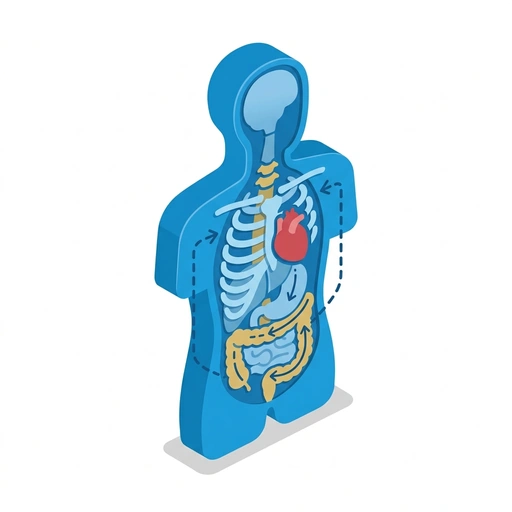
Mapping Human Anatomy
Learn the universal spatial coordinates and structural blueprints of the human body. Build the mental models required to locate, slice, and navigate anatomical structures with clinical precision.
Like Duolingo, but for Mapping Human Anatomy. Tomo turns the whole topic into a game you play five minutes a day, until it actually sticks.
A short one: 12 levels across 2 sections, about 24 minutes end to end, roughly 5 days at five minutes a day. It moves through The Body's Coordinate System and Depth, Scaffolding, and Cavities. It starts from scratch.
Free forever · No credit card · iPhone & Android
Key ideas in Mapping Human Anatomy
- Standard anatomical position always serves as the fixed neutral frame of reference
- Directional terms describe body parts relative to the standard stance, not the current posture
- Palms face forward in the standard reference position to prevent arm bones from crossing
- Superior means closer to the head along the vertical axis
- Inferior means closer to the feet along the vertical axis
- These terms replace everyday words like 'above' and 'below' so orientation remains unambiguous
- Anterior always refers to the front of the body and posterior to the back
- Bending over, curling into a ball, or lying down does not alter front-to-back axes
- The kneecap remains permanently anterior to the back of the knee
- Medial means closer to the vertical midline of the body
- Lateral means farther away from the vertical midline toward the outer edge
- With palms facing forward, the thumb points outward to the side and the pinky sits closest to the hip
- Proximal means closer to where the limb connects to the torso trunk
- Distal means farther out along the limb toward the fingers or toes
- Limb points are measured along the length of the appendage, not by elevation above the ground
- Sagittal cuts run vertically from front to back, splitting left from right
You've tried the other tabs
Thirty open tabs. Four facts you actually kept.
You watched. You nodded. By Sunday it was gone.
One answer, then back to scrolling.
Eight weeks. You meant to finish. You didn't.
Tomo gives Mapping Human Anatomy the Duolingo treatment: levels, streaks, and quick quizzes that test what you just learned. That game loop is what the tabs above never had, so it's the one you actually finish.
Here's what playing it feels like
A real question from this course. Take your best guess.
A patient is curled up in a chair. How do doctors describe where an injury is located?
Get it right to open this lesson and 11 more in the app.
Where Mapping Human Anatomy takes you
- 1
The Body's Coordinate System
- The Universal Reference Stance and Directional Pairs
- Slicing 3D Space with Cardinal Planes
- 2
Depth, Scaffolding, and Cavities
- Navigating Depth from Skin to Bone
- Mapping Internal Cavities and Boundaries
2 sections · 4 units · 12 levels. Built to play, not to enroll.
You pick the voice
Mapping Human Anatomy is taught in the The Bestie style: your friend who just gets it. Want a different feel? In the app you can spin up the same topic in any of Tomo's teaching styles. Same facts, totally different vibe.
More Science on Tomo
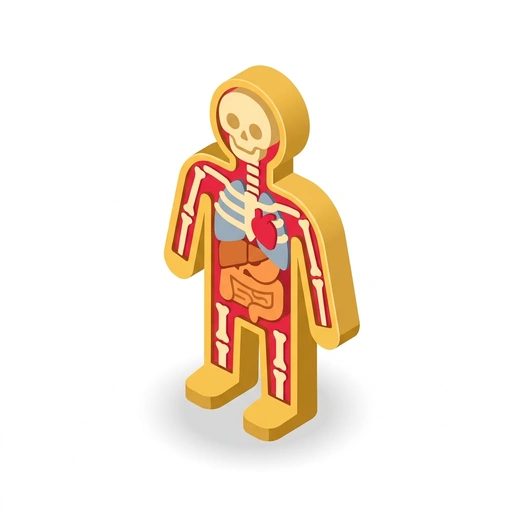
Anatomy of the Human Body
Discover how your bones, muscles, and internal systems coordinate every breath and step. Understand the physical machinery that powers daily movement, circulation, and sensation.
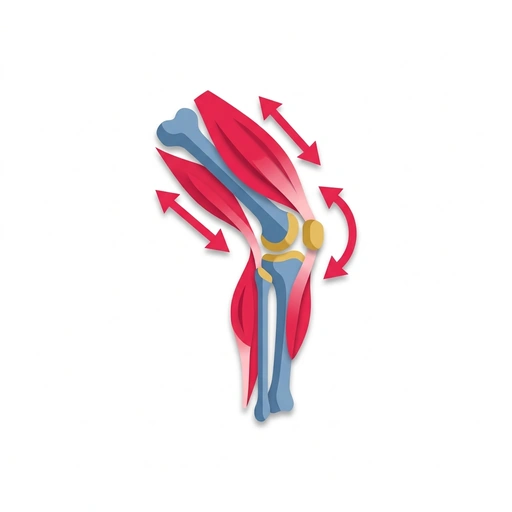
Musculoskeletal Biomechanics
Examine how the human body turns tissue into mechanical power. Learn how bones, joints, and muscles operate as living lever systems, generate force across variable joint angles, and physically adapt to mechanical load.
Human Muscle Anatomy
Discover how facial expressions, posture, and athletic movements actually work from the inside out. Learn the major muscle groups of the human body and the physiological mechanics behind every motion.

Biology in Your Daily Life
Discover how the invisible machinery of life explains everything from why you get hungry to how your body fights off a cold.

How the Human Body Works
Discover how your body coordinates movement, fuels your cells, and keeps you alive. Learn the mechanics behind everyday sensations from your heartbeat to muscle fatigue.
Human Anatomy: Form and Function
Bridge the gap between basic body parts and true functional anatomy. Discover how bones, muscles, nerves, and organs mechanically coordinate to sustain motion, regulate pressure, and maintain life.
Start Mapping Human Anatomy today.
Download Tomo, search Mapping Human Anatomy, and play your first lesson in under a minute.