
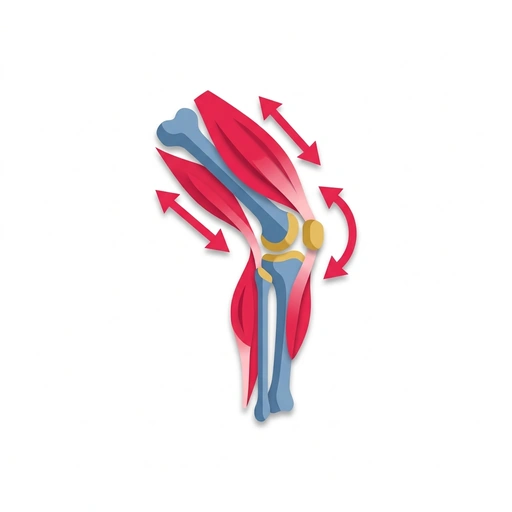
Musculoskeletal Biomechanics
Examine how the human body turns tissue into mechanical power. Learn how bones, joints, and muscles operate as living lever systems, generate force across variable joint angles, and physically adapt to mechanical load.
Like Duolingo, but for Musculoskeletal Biomechanics. Tomo turns the whole topic into a game you play five minutes a day, until it actually sticks.
A short one: 11 levels across 2 sections, about 22 minutes end to end, roughly 4 days at five minutes a day. It moves through The Body as a Mechanical Linkage and Tissue Dynamics Under Load. It assumes you already know the basics.
Free forever · No credit card · iPhone & Android
Key ideas in Musculoskeletal Biomechanics
- Effort between fulcrum and load demands muscle force far greater than the load
- A small shortening at the tendon creates huge sweeping speed at the distal limb
- Placing insertions close to joints trades force capacity for rapid, wide movement
- Torque equals muscle contractile tension multiplied by its perpendicular moment arm
- Moment arm length shifts dynamically through joint rotation, peaking near 90 degrees
- Active sarcomere overlap peaks at mid-length, which rarely matches peak moment arm
- Second-class levers place load between fulcrum and effort, yielding leverage > 1
- Calf raises pivot on the metatarsals to lift full body weight with small displacement
- First-class levers like the atlanto-occipital joint prioritize balance over amplification
- The patella lifts the patellar tendon anteriorly away from the knee joint axis
- Increasing the distance from the joint axis enlarges the extensor moment arm
- Bony pulleys hold tendon vectors at effective angles across the entire flexion arc
- Muscle moment arms are tiny compared to the external resistance arm
- Muscles must exert massive internal force to counter external torque
- Antagonist co-contraction pulls articulating bones directly together
- Proteoglycans and fluid pressurization absorb compressive shock
You've tried the other tabs
Thirty open tabs. Four facts you actually kept.
You watched. You nodded. By Sunday it was gone.
One answer, then back to scrolling.
Eight weeks. You meant to finish. You didn't.
Tomo gives Musculoskeletal Biomechanics the Duolingo treatment: levels, streaks, and quick quizzes that test what you just learned. That game loop is what the tabs above never had, so it's the one you actually finish.
Here's what playing it feels like
A real question from this course. Take your best guess.
When your muscle pulls near a joint, how does a tiny contraction affect your hand or foot?
Get it right to open this lesson and 10 more in the app.
Where Musculoskeletal Biomechanics takes you
- 1
The Body as a Mechanical Linkage
- Decoding Human Lever Classes
- Forces Across the Joint System
- 2
Tissue Dynamics Under Load
- Muscle Architecture and Force Production
- Bone Mechanics and Structural Adaptation
2 sections · 4 units · 11 levels. Built to play, not to enroll.
You pick the voice
Musculoskeletal Biomechanics is taught in the The Bestie style: your friend who just gets it. Want a different feel? In the app you can spin up the same topic in any of Tomo's teaching styles. Same facts, totally different vibe.
More Science on Tomo
Functional Human Anatomy
Bridge the gap between anatomical names and how the living body actually moves. Discover how bones, joints, muscles, and neural circuits collaborate to generate force and control motion.
Human Anatomy: Bones and Muscle
Move beyond memorizing muscle and bone names to understand how the human musculoskeletal system functions as an integrated mechanical machine. Learn how joints dictate movement, why muscles operate in coupled pairs, and how living tissue remodels under load.
Bones, Muscles, and Movement
Go beyond naming parts to understand how the human frame generates power, maintains stability, and adapts to the physical world.
How the Human Body Works
Discover how your body coordinates movement, fuels your cells, and keeps you alive. Learn the mechanics behind everyday sensations from your heartbeat to muscle fatigue.
Functional Anatomy: How the Body Handles Force
Move past rote memorization of muscle names and discover the biomechanical architecture of the human body. Learn how moment arms, two-joint muscle dynamics, core hydraulics, and elastic fascia manage force and movement.
Human Anatomy and Physiology in Practice
Go beyond basic diagrams to master the functional systems of the body. Learn how physiological mechanisms drive clinical diagnosis, natural healing, and peak human performance.
Start Musculoskeletal Biomechanics today.
Download Tomo, search Musculoskeletal Biomechanics, and play your first lesson in under a minute.