
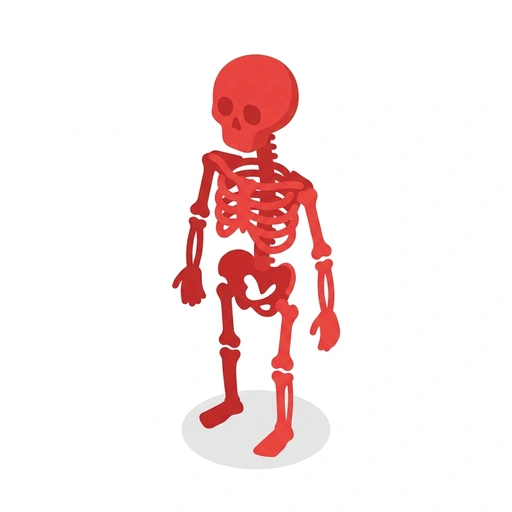
Mapping the Human Body
Discover how the living human body is built, organized, and engineered to function. Learn to read anatomical landmarks, understand how joints and muscles generate motion, and trace how internal organs coordinate life beneath your skin.
Like Duolingo, but for Mapping the Human Body. Tomo turns the whole topic into a game you play five minutes a day, until it actually sticks.
25 levels across 3 sections, about 50 minutes end to end, roughly 10 days at five minutes a day. It moves through How the Body Moves and Holds Itself Up; The Inner Pipeline: Air, Blood, and Fuel; and Coordination, Filtering, and Defense. It starts from scratch.
Free forever · No credit card · iPhone & Android
Key ideas in Mapping the Human Body
- In anatomical position, the body is treated as standing upright facing forward with palms forward, regardless of how the person is actually lying or curled up
- 'Superior' always points toward the head as defined by this standard pose, not toward the ceiling of the room
- Directional anatomical terms describe one structure's position relative to another, not a fixed absolute label
- The heart sits posterior to (behind) the breastbone, but anterior to (in front of) the spine
- Bones that sit directly beneath the skin don't shift and can be felt from the outside
- Clinicians use these firm, unchanging bone edges as landmarks to reliably pinpoint soft organs, pulses, and nerves beneath
- The body divides its interior into fluid-lined cavities (like the thoracic and abdominopelvic cavities)
- The fluid lubricating these cavity linings allows vital organs to slide, expand, and absorb physical shock without rubbing abrasively against neighboring organs
- While the skeleton and outer muscles form a mirrored left-right pair, most internal visceral organs are single and offset
- The bulky liver occupies most of the upper right abdomen, while the spleen tucks into the upper left
- Kidneys and lungs exist as paired structures on both sides of the midline
- Bone is living tissue that constantly remodels itself depending on how much physical demand is placed on it
- Weight-bearing exercise and gravity signal bones to lay down more minerals and stay strong
- Without regular physical resistance or gravity, the body resorbs bone material faster than it builds it
- The axial skeleton forms the central axis of the body (skull, spine, ribs) designed primarily to protect vital organs
- The appendicular skeleton consists of the limbs and their girdles, adapted to act as levers for movement and handling objects
You've tried the other tabs
Thirty open tabs. Four facts you actually kept.
You watched. You nodded. By Sunday it was gone.
One answer, then back to scrolling.
Eight weeks. You meant to finish. You didn't.
Tomo gives Mapping the Human Body the Duolingo treatment: levels, streaks, and quick quizzes that test what you just learned. That game loop is what the tabs above never had, so it's the one you actually finish.
Here's what playing it feels like
A real question from this course. Take your best guess.
A person is lying flat on their back on an exam table. Which direction does 'superior' point?
Get it right to open this lesson and 24 more in the app.
Where Mapping the Human Body takes you
- 1
How the Body Moves and Holds Itself Up
- Finding Your Way Around the Body
- The Skeleton as an Architecture of Levers
- How Muscles Pull the World
- 2
The Inner Pipeline: Air, Blood, and Fuel
- Breath Mechanics and Gas Exchange
- The Circulatory Loop and the Heart
- Digestion and Nutrient Extraction
- 3
Coordination, Filtering, and Defense
- The Nervous System and Reflex Arcs
- Waste Clearance, Fluid Balance, and Skin
3 sections · 8 units · 25 levels. Built to play, not to enroll.
Tomo is in ChatGPT
Tomo is also a ChatGPT plugin: the same playable courses, built and played inside your chat.
Add Tomo to ChatGPT- What to ask
- “Make me a Tomo course on black holes.” “Turn this chat into a Tomo course.”
- What you get
- Quick questions with instant feedback, hearts and stars, ready to play in about a minute.
- Where it goes
- No sign-up to start. Connect your Tomo account and your streak carries on in the app.
You pick the voice
Mapping the Human Body is taught in the Professor style: clear, structured, thorough. Want a different feel? In the app you can spin up the same topic in any of Tomo's teaching styles. Same facts, totally different vibe.
More Science on Tomo
How the Human Body Works
Discover how your organs, tissues, and fluids coordinate every second of the day. Learn the elegant mechanics behind how you move, breathe, fight disease, and stay alive.
How the Human Body Works
Discover how your body functions as an interconnected living machine. Explore the mechanics of bones and muscles, the heart and lungs' oxygen highway, digestive fuel conversion, and the nervous system's command center.
How the Human Body Works
Discover the mechanical and chemical principles that keep your body alive and moving. Learn how organs coordinate behind the scenes, how muscles generate force, and how your system automatically balances itself.
How the Human Body Works
Discover the incredible machinery of human anatomy and physiology. Learn how your bones, muscles, nerves, and organs work together in real time to keep you moving, thinking, and alive.
How the Human Body Is Built
Discover the physical architecture that keeps you moving, breathing, and alive. From the mechanical levers of your skeleton to the internal plumbing of your organs, learn to read the map of your own body with clarity and confidence.
How the Human Body Works
Discover how your body coordinates movement, fuels your cells, and keeps you alive. Learn the mechanics behind everyday sensations from your heartbeat to muscle fatigue.
Start Mapping the Human Body today.
Download Tomo, search Mapping the Human Body, and play your first lesson in under a minute.