
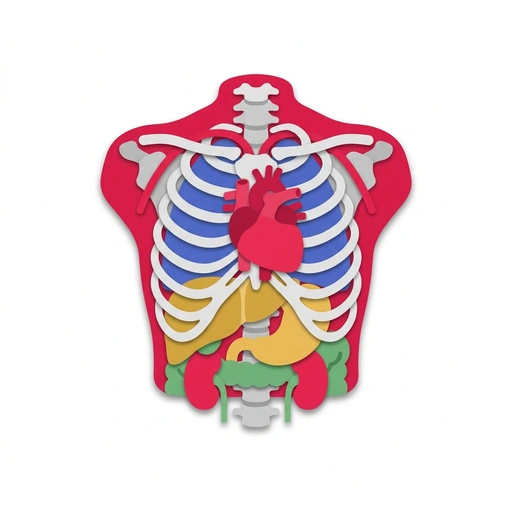
The Architecture of the Human Body
Understand how the human body really fits together, from bony landmarks and force-transmitting joints to visceral compartments and neurovascular routes.
Like Duolingo, but for The Architecture of the Human Body. Tomo turns the whole topic into a game you play five minutes a day, until it actually sticks.
24 levels across 4 sections, about 48 minutes end to end, roughly 10 days at five minutes a day. It moves through Surface Landmarks and Navigational Anatomy, Mechanics of the Moving Frame, Internal Conduits and Organ Geography, and Neural Pathways and Fascial Integration. It assumes you already know the basics.
Free forever · No credit card · iPhone & Android
Key ideas in The Architecture of the Human Body
- Bony prominences remain rigid and reliable reference points regardless of limb posture.
- Skin creases, fat pads, and muscle bellies slide and distort as joints flex and extend.
- The femoral epicondyles provide fixed bony margins to orient joint space palpation.
- Tendons become prominent and tense only when their muscle contracts against resistance.
- Tibialis anterior dorsiflexes and inverts the foot; resisting dorsiflexion tenses its tendon.
- Resisting plantarflexion relaxes the tibialis anterior and tenses the Achilles tendon.
- Palpating a pulse requires compressing the artery against a hard underlying bony floor.
- Vessels surrounded only by thick soft tissue dissipate pulsatile pressure without tactile feedback.
- Key arterial pulse points correspond to fixed skeletal backstops across the body.
- Each spinal nerve root innervates a distinct strip-like zone of skin called a dermatome.
- The C5 dermatome covers the lateral shoulder and regimental badge area over the deltoid.
- Anatomical triangles form where intersecting muscular boundaries create shallow fascial windows.
- The carotid and femoral triangles bring large arterial trunks within millimeters of the surface.
- Regions like the gluteal bed are heavily shielded by thick muscle layers that bury vital nerves.
- The C7 dermatome supplies the middle finger, while T1 supplies the medial forearm.
- A deep bony socket with snug ligamentous wrappings maximizes passive joint stability at the expense of range of motion.
You've tried the other tabs
Thirty open tabs. Four facts you actually kept.
You watched. You nodded. By Sunday it was gone.
One answer, then back to scrolling.
Eight weeks. You meant to finish. You didn't.
Tomo gives The Architecture of the Human Body the Duolingo treatment: levels, streaks, and quick quizzes that test what you just learned. That game loop is what the tabs above never had, so it's the one you actually finish.
Here's what playing it feels like
A real question from this course. Take your best guess.
What happens to soft tissues like skin creases, fat pads, and muscle bellies when a joint moves?
Get it right to open this lesson and 23 more in the app.
How to learn The Architecture of the Human Body, step by step
Go in order. 24 short levels across 4 sections, about 48 minutes in all, five minutes a day.
- 1
Surface Landmarks and Navigational Anatomy
- Navigating by Bone, Tendon, and Pulse
- 2
Mechanics of the Moving Frame
- Joint Architecture and Articular Restraint
- Muscle Action and Functional Slings
- The Axial Core and Spinal Column
- 3
Internal Conduits and Organ Geography
- Circulatory Routing and Fluid Dynamics
- Visceral Topography and Peritoneal Spaces
- 4
Neural Pathways and Fascial Integration
- Peripheral Nerve Paths and Plexuses
- Fascial Continuity and Structural Integration
4 sections · 8 units · 24 levels. Built to play, not to enroll.
Questions about The Architecture of the Human Body
How do I learn The Architecture of the Human Body?
Go in order: start with Surface Landmarks and Navigational Anatomy, then Mechanics of the Moving Frame, then Internal Conduits and Organ Geography, then Neural Pathways and Fascial Integration. On Tomo that's 24 short levels, about 48 minutes in all, played five minutes a day. Start free and play the first level in under a minute.
Is there a Duolingo-style app for The Architecture of the Human Body?
Yes. Tomo works like Duolingo: short daily lessons, streaks and quick quizzes. The Architecture of the Human Body is one of its free courses, and you can type any other topic to get a course of your own.
Is The Architecture of the Human Body free?
Yes. The Architecture of the Human Body is playable on Tomo's free plan, which doesn't expire. No credit card, no waitlist. Download the app and start your first lesson.
How long does it take to learn The Architecture of the Human Body?
24 levels across 4 sections, about 48 minutes of play in total. It's built for five minutes a day, so you finish it a little at a time instead of all at once.
Do I need any background to start The Architecture of the Human Body?
No. It's pitched at an intermediate level, so it starts where you are and builds up. If you can tap a phone, you can start.
Tomo is in ChatGPT
Tomo is also a ChatGPT plugin: the same playable courses, built and played inside your chat.
Add Tomo to ChatGPT- What to ask
- “Make me a Tomo course on black holes.” “Turn this chat into a Tomo course.”
- What you get
- Quick questions with instant feedback, hearts and stars, ready to play in about a minute.
- Where it goes
- No sign-up to start. Connect your Tomo account and your streak carries on in the app.
You pick the voice
The Architecture of the Human Body is taught in the Bestie style: your friend who just gets it. Want a different feel? In the app you can spin up the same topic in any of Tomo's teaching styles. Same facts, totally different vibe.
More Science on Tomo
Functional Human Anatomy
Bridge the gap between anatomical names and how the living body actually moves. Discover how bones, joints, muscles, and neural circuits collaborate to generate force and control motion.
Functional Human Anatomy
Understand how the human body operates as an integrated mechanical and physiological system. Explore joint levers, vascular pressure gradients, organ compartmentalization, and deep neural wiring.
Applied Human Anatomy
Bridge the gap between textbook organ lists and real human function. Learn how fascial planes, neurovascular pathways, and visceral architecture shape the living body.
Clinical Human Anatomy
Examine the topographical landmarks, fascial planes, and neurovascular crossroads that govern human function. Move beyond rote memorization to analyze structural vulnerabilities, collateral pathways, and clinical relationships.
Anatomy: Bones, Muscles, and Nerves
Bridge the gap between memorizing isolated terms and understanding the human body as an integrated machine. Master skeletal landmarks, muscle attachment logic, and peripheral nerve pathways.
Human Anatomy: Form and Function
Bridge the gap between basic body parts and true functional anatomy. Discover how bones, muscles, nerves, and organs mechanically coordinate to sustain motion, regulate pressure, and maintain life.
Start The Architecture of the Human Body today.
Download Tomo, search The Architecture of the Human Body, and play your first lesson in under a minute.