
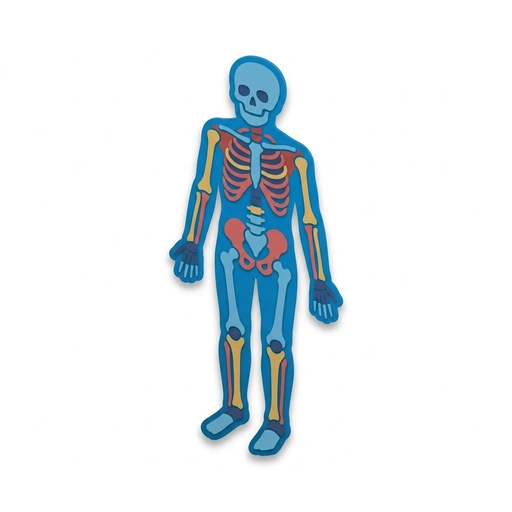
Functional Human Anatomy
Bridge the gap between anatomical names and how the living body actually moves. Discover how bones, joints, muscles, and neural circuits collaborate to generate force and control motion.
Like Duolingo, but for Functional Human Anatomy. Tomo turns the whole topic into a game you play five minutes a day, until it actually sticks.
21 levels across 3 sections, about 42 minutes end to end, roughly 8 days at five minutes a day. It moves through Joint Mechanics and Muscle Force, The Neural Wiring: PNS and Reflexes, and Central Command and Structural Adaptation. It assumes you already know the basics.
Free forever · No credit card · iPhone & Android

Key ideas in Functional Human Anatomy
- Hinge joints restrict articulation to uniaxial flexion-extension
- Saddle joints permit biaxial movement but forbid axial rotation
- Spherical ball-and-socket articulations allow triaxial movement
- Ligaments mechanically check passive translation at end-range
- Tendons channel muscular contraction forces to displace bone
- Ligamentous collagen resists tension without contracting actively
- Third-class levers place the effort between the fulcrum and load
- Effort arm is shorter than load arm, creating mechanical disadvantage
- Small muscle contractions produce large, rapid distal limb excursions
- Loose-packed positions maximize joint space and minimize intracapsular pressure
- Close-packed positions lock articular surfaces in maximal congruent contact
- Loose-packed alignment yields lax capsule and ligaments to permit joint play
- Adult hyaline cartilage is avascular and relies entirely on diffusion
- Cyclic compression drives fluid flow for chondrocyte nutrition
- Articular cartilage flattens to disperse focal stresses to subchondral bone
- Pennation angles allow more muscle fibers to pack into a shared cross-sectional area
You've tried the other tabs
Thirty open tabs. Four facts you actually kept.
You watched. You nodded. By Sunday it was gone.
One answer, then back to scrolling.
Eight weeks. You meant to finish. You didn't.
Tomo gives Functional Human Anatomy the Duolingo treatment: levels, streaks, and quick quizzes that test what you just learned. That game loop is what the tabs above never had, so it's the one you actually finish.
Here's what playing it feels like
A real question from this course. Take your best guess.
Your thumb's base is a saddle joint. Which movement pattern does this interlocking shape permit?
Get it right to open this lesson and 20 more in the app.
Where Functional Human Anatomy takes you
- 1
Joint Mechanics and Muscle Force
- Mapping Joint Articulations and Movement
- Muscle Architecture and Contraction Dynamics
- 2
The Neural Wiring: PNS and Reflexes
- Peripheral Nerve Paths and Plexuses
- Proprioceptive Sensors and Reflex Circuits
- 3
Central Command and Structural Adaptation
- CNS Motor Pathways and Brainstem Control
- Bone Architecture and Adaptive Remodeling
- Pathomechanics of Entrapment and Joint Wear
3 sections · 7 units · 21 levels. Built to play, not to enroll.
You pick the voice
Functional Human Anatomy is taught in the The Professor style: clear, structured, thorough. Want a different feel? In the app you can spin up the same topic in any of Tomo's teaching styles. Same facts, totally different vibe.
More Science on Tomo
Human Anatomy: Bones and Muscle
Move beyond memorizing muscle and bone names to understand how the human musculoskeletal system functions as an integrated mechanical machine. Learn how joints dictate movement, why muscles operate in coupled pairs, and how living tissue remodels under load.
Bones, Muscles, and Movement
Go beyond naming parts to understand how the human frame generates power, maintains stability, and adapts to the physical world.
Human Anatomy and Physiology in Practice
Go beyond basic diagrams to master the functional systems of the body. Learn how physiological mechanisms drive clinical diagnosis, natural healing, and peak human performance.
Human Anatomy and Physiology
Go beyond basic diagrams to master the complex mechanical and chemical interactions that sustain human life. This course bridges the gap between structural form and clinical function for a professional-grade understanding of the body.
Functional Anatomy: How the Body Handles Force
Move past rote memorization of muscle names and discover the biomechanical architecture of the human body. Learn how moment arms, two-joint muscle dynamics, core hydraulics, and elastic fascia manage force and movement.
Applied Human Anatomy
Decode the architectural logic of the human body through topographical relationships, fascial planes, and systemic structural design. Move beyond simple memorization to understand how form governs function across every major system.
Start Functional Human Anatomy today.
Download Tomo, search Functional Human Anatomy, and play your first lesson in under a minute.