
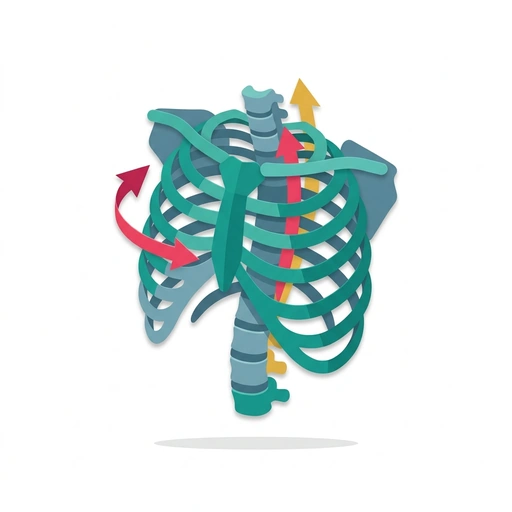
Pilates Anatomy in Motion
Like Duolingo, but for Pilates Anatomy in Motion. Tomo turns the whole topic into a game you play five minutes a day, until it actually sticks.
For the part of you with thirty open tabs that never became anything.
21 levels across 3 sections, about 42 minutes end to end, roughly 8 days at five minutes a day. It moves through The Dynamic Powerhouse; Kinematic Chains in Motion; and Patterns, Slings, and Adaptations. It assumes you already know the basics.
Free forever · No credit card · iPhone & Android

Key ideas in Pilates Anatomy in Motion
- Deep local stabilizers fire milliseconds prior to peripheral limb movement
- Feed-forward activation happens automatically to secure spine stiffness
- Voluntarily sucking the belly inward after movement starts misses the stabilization window
- Abdominal hollowing increases spinal compressive loads on lumbar discs
- Functional bracing relies on 360-degree cylindrical intra-abdominal pressure
- Circumferential expansion stabilizes the lumbar spine without locking motion
- The pelvic floor moves in tandem with the thoracic diaphragm like an elastic piston
- Inhalation lowers the pelvic floor while exhalation assists its upward recoil
- Constant clenching prevents natural intra-abdominal pressure management
- ASIS landmarks and the pubic symphysis rest in a level horizontal plane
- A natural small lumbar curve is preserved rather than pressed flat
- Individual skeletal variations mean floor contact under the lower back varies across bodies
- Distal reaching cues trigger myofascial slings and automatic deep stabilization
- Internal cues to squeeze the abs evoke superficial bracing and restrict hip mobility
- Lengthening the crown and toe establishes tension through functional kinetic chains
- Lateral costal breathing expands ribs outward while keeping the transverse abdominis drawn inward.
You've tried the other tabs
Thirty open tabs. Four facts you actually kept.
You watched. You nodded. By Sunday it was gone.
One answer, then back to scrolling.
Eight weeks. You meant to finish. You didn't.
Tomo gives Pilates Anatomy in Motion the Duolingo treatment: levels, streaks, and quick quizzes that test what you just learned. That game loop is what the tabs above never had, so it's the one you actually finish.
Here's what playing it feels like
A real question from this course. Take your best guess.
How does feed-forward activation protect your spine when you reach or lift?
Get it right to open this lesson and 20 more in the app.
Where Pilates Anatomy in Motion takes you
Look past generic cues and uncover the biomechanics behind every roll, reach, and teaser. Learn how deep stabilizers, myofascial slings, and joint mechanics work together to build effortless, injury-free movement.
- 1
The Dynamic Powerhouse
- Core Stability Beyond Navel-to-Spine
- Breath Mechanics and Pressure Regulation
- 2
Kinematic Chains in Motion
- Segmental Spinal Articulation
- Lumbopelvic Control and Hip Dissociation
- Scapular Stability and Upper-Body Mechanics
- 3
Patterns, Slings, and Adaptations
- Myofascial Slings and Rotational Force
- Kinetic Compensations and Lever Adaptations
3 sections · 7 units · 21 levels. Built to play, not to enroll.
You pick the voice
Pilates Anatomy in Motion is taught in the The Professor style: clear, structured, thorough. Want a different feel? In the app you can spin up the same topic in any of Tomo's teaching styles. Same facts, totally different vibe.
More Health on Tomo
Anatomy for Pilates Professionals
Bridge the gap between textbook anatomy and the moving body. Master the musculoskeletal relationships that drive core stability, spinal articulation, and efficient movement patterns in your clients.
Anatomy for Pilates Movement
Bridge the gap between textbook anatomy and movement instruction. Understand joint mechanics, muscular lines of pull, and functional compensations across the classic and contemporary Pilates repertoire.
Pilates Anatomy: Movement from Within
Discover how your muscles and bones work together to create the strength, length, and control that define the Pilates method.
Pilates Anatomy: The Body in Motion
Understand how your muscles and bones work together to create the strength and control that defines Pilates. Learn to move from your center and protect your spine with every breath.
Pilates: Strength through Control
Build a resilient body and a focused mind by mastering the powerhouse. This course takes you from your first lateral breath to the fluid, precise movements that define the Pilates method.
Anatomy for Pilates Instruction
Bridge the gap between textbook anatomy and the moving body. Learn to see beneath the skin to refine your cueing, correct compensations, and deepen your students' mind-body connection.
Start Pilates Anatomy in Motion today.
Download Tomo, search Pilates Anatomy in Motion, and play your first lesson in under a minute.