
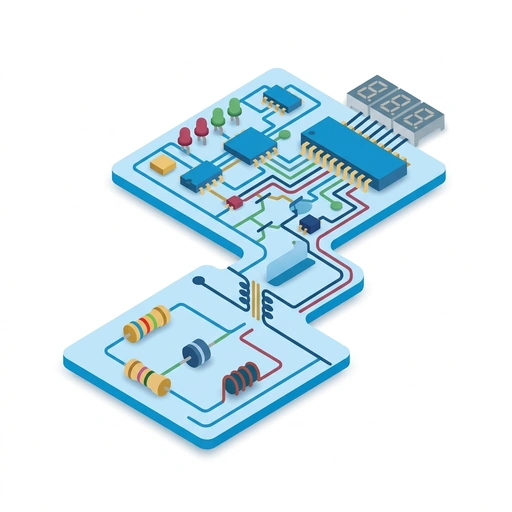
Real-World Circuit Design
Bridge the gap between foundational physics and functional hardware engineering. Learn to select components, drive real-world loads from digital logic, regulate power safely, and layout reliable physical circuits on the job.
Like Duolingo, but for Real-World Circuit Design. Tomo turns the whole topic into a game you play five minutes a day, until it actually sticks.
A deep dive: 47 levels across 5 sections, about 94 minutes end to end, roughly 19 days at five minutes a day. It moves through Making Circuits Work, Bridging Logic to the Physical World, Conditioning Analog Signals for Computing, Power Distribution and Circuit Protection, and From Schematic to Physical Hardware. It starts from scratch.
Free forever · No credit card · iPhone & Android

Key ideas in Real-World Circuit Design
- Voltage is the electrical push or pressure supplied by a battery or power source
- Current is the actual rate of electric charge moving through the circuit
- Resistance restricts the flow of electric charge, keeping the current under control
- Components like LEDs have a strict maximum current rating (often around 20–30 mA for basic indicators)
- Too much current flowing through a component generates rapid heat inside its tiny internal structure
- Without a resistor to restrict the flow, excessive current burns out the component within milliseconds
- A diode or LED has a threshold called forward voltage drop that must be met before it starts conducting electricity
- If the power supply voltage is lower than the LED's forward drop threshold, essentially zero current flows and the LED stays completely dark
- LEDs do not turn on gradually from 0V; they remain off until their threshold voltage is reached
- Identify the supply voltage, the LED's forward drop, and the desired safe operating current
- Subtract the LED's forward voltage from the supply voltage to find the remaining voltage the resistor must absorb
- Apply Ohm's law by dividing that remaining voltage by the target current to find the resistance in ohms
- A short circuit occurs when a path of near-zero resistance connects power directly back to ground
- With near-zero resistance, current surges to the absolute maximum the power source can output
- Massive current flow causes rapid overheating, potentially melting breadboard plastic, damaging batteries, or burning traces
- In a series circuit, identical resistors share the total voltage equally
You've tried the other tabs
Thirty open tabs. Four facts you actually kept.
You watched. You nodded. By Sunday it was gone.
One answer, then back to scrolling.
Eight weeks. You meant to finish. You didn't.
Tomo gives Real-World Circuit Design the Duolingo treatment: levels, streaks, and quick quizzes that test what you just learned. That game loop is what the tabs above never had, so it's the one you actually finish.
Here's what playing it feels like
A real question from this course. Take your best guess.
What is electrical current in a circuit?
Get it right to open this lesson and 46 more in the app.
How to learn Real-World Circuit Design, step by step
Go in order. 47 short levels across 5 sections, about 1 hour 34 minutes in all, five minutes a day.
- 1
Making Circuits Work
- Powering Your First Component Safely
- Voltage Dividers and Digital Referencing
- Benchtop Diagnostics with a Multimeter
- 2
Bridging Logic to the Physical World
- Transistors as Digital Power Switches
- Handling Inductive Kickback and Mechanical Noise
- Smoothing and Timing with Capacitors
- 3
Conditioning Analog Signals for Computing
- Interfacing Real-World Sensors
- Operational Amplifiers for Buffering and Gain
- Hardware Noise Filtering
- 4
Power Distribution and Circuit Protection
- Voltage Regulation and Thermal Management
- Circuit Protection Engineering
- 5
From Schematic to Physical Hardware
- Schematic Architecture and Design Intent
- Practical PCB Layout and Prototyping
- Systematic Hardware Debugging on the Bench
5 sections · 14 units · 47 levels. Built to play, not to enroll.
Questions about Real-World Circuit Design
How do I learn Real-World Circuit Design?
Go in order: start with Making Circuits Work, then Bridging Logic to the Physical World, then Conditioning Analog Signals for Computing, then Power Distribution and Circuit Protection, and 1 more section after that. On Tomo that's 47 short levels, about 1 hour 34 minutes in all, played five minutes a day. Start free and play the first level in under a minute.
Is there a Duolingo-style app for Real-World Circuit Design?
Yes. Tomo works like Duolingo: short daily lessons, streaks and quick quizzes. Real-World Circuit Design is one of its free courses, and you can type any other topic to get a course of your own.
Is the Real-World Circuit Design course free?
Yes. Real-World Circuit Design is playable on Tomo's free plan, which doesn't expire. No credit card, no waitlist. Download the app and start your first lesson.
How long does it take to learn Real-World Circuit Design?
47 levels across 5 sections, about 1 hour 34 minutes of play in total. It's built for five minutes a day, so you finish it a little at a time instead of all at once.
Do I need any background to start Real-World Circuit Design?
No. It's pitched at a beginner level, so it starts where you are and builds up. If you can tap a phone, you can start.
Tomo is in ChatGPT
Tomo is also a ChatGPT plugin: the same playable courses, built and played inside your chat.
Add Tomo to ChatGPT- What to ask
- “Make me a Tomo course on black holes.” “Turn this chat into a Tomo course.”
- What you get
- Quick questions with instant feedback, hearts and stars, ready to play in about a minute.
- Where it goes
- No sign-up to start. Connect your Tomo account and your streak carries on in the app.
You pick the voice
Real-World Circuit Design is taught in the Professor style: clear, structured, thorough. Want a different feel? In the app you can spin up the same topic in any of Tomo's teaching styles. Same facts, totally different vibe.
More Technology on Tomo
Circuit Design for Arduino
Bridge the gap between microcontroller code and reliable hardware. Learn how to drive high-power loads, clean up noisy sensor readings, stabilize power delivery, and protect components from catastrophic damage.
Practical Circuit Engineering
Bridge the gap between schematic diagrams and working bench hardware. Learn to select components, drive real-world loads, condition analog signals, and diagnose parasitic gremlins.
Building Working Circuits
Bridge the gap between textbook schematics and hardware that actually turns on and runs reliably. Learn to select the right components, tame noise and power drops, and diagnose real circuits on the bench.
Practical Circuit Design
Move beyond basic breadboard recipes to design reliable, real-world circuits. Learn to drive high-power loads, shape signals with op-amps, clean up noisy power rails, and debug circuits with confidence.

Designing Electronic Systems
Bridge the gap between simple breadboard circuits and robust, functional hardware systems. Learn how to condition analog signals, manage power and switching loads, coordinate noisy digital communication, and track down real-world hardware bugs.
Electronics: Making Real Circuits Work
Bridge the gap between theoretical schematics and physical hardware that actually functions as intended. Learn to tame power supply sag, drive heavy loads without damaging components, condition noisy signals, and isolate elusive circuit faults.
Start Real-World Circuit Design today.
Download Tomo, search Real-World Circuit Design, and play your first lesson in under a minute.