
Functional Human Anatomy
Understand how the human body operates as an integrated mechanical and physiological system. Explore joint levers, vascular pressure gradients, organ compartmentalization, and deep neural wiring.
Like Duolingo, but for Functional Human Anatomy. Tomo turns the whole topic into a game you play five minutes a day, until it actually sticks.
24 levels across 4 sections, about 48 minutes end to end, roughly 10 days at five minutes a day. It moves through Mechanics of Movement and Load; Pressure, Flow, and Gas Exchange; Visceral Architecture and Internal Crossroads; and Control Networks and Structural Routing. It assumes you already know the basics.
Free forever · No credit card · iPhone & Android
Key ideas in Functional Human Anatomy
- In a third-class lever, the effort inserts between the joint fulcrum and the load.
- Third-class levers require more muscle tension than load weight but amplify distal speed.
- Small muscle contractions produce large, rapid excursions of the hand or foot.
- Deep bony sockets increase joint stability but physically restrict angular mobility.
- Shallow fossae grant extreme range of motion by relying on vulnerable soft tissues.
- Capsular tightness and ligamentous check-reins trade motion freedom for dislocation resistance.
- Pennate fibers attach obliquely to a central tendon, packing more cross-sectional area into a volume.
- Higher physiological cross-sectional area dramatically increases peak contractile tension.
- Angled muscle fibers shorten over a shorter total excursion distance than parallel fibers.
- Antagonists fire eccentrically at end-range to brake limb momentum and protect ligaments.
- Co-contraction increases joint compressive forces to center the articulating bones.
- Antagonists act as dynamic stabilizers rather than passive or completely relaxed opponents.
- Open-chain movements isolate motion to one joint, generating substantial linear shear stress.
- Closed-chain movements fix the distal end, transmitting axial compression across multiple joints.
- Multi-joint closed chains recruit surrounding co-contractors that cushion individual capsules.
- Deep investing fascia forms a continuous fibrous network rather than isolating individual muscles.
You've tried the other tabs
Thirty open tabs. Four facts you actually kept.
You watched. You nodded. By Sunday it was gone.
One answer, then back to scrolling.
Eight weeks. You meant to finish. You didn't.
Tomo gives Functional Human Anatomy the Duolingo treatment: levels, streaks, and quick quizzes that test what you just learned. That game loop is what the tabs above never had, so it's the one you actually finish.
Here's what playing it feels like
A real question from this course. Take your best guess.
Third-class levers demand more muscle pull than the actual weight of the load. What treasure do ye get in return?
Get it right to open this lesson and 23 more in the app.
How to learn Functional Human Anatomy, step by step
Go in order. 24 short levels across 4 sections, about 48 minutes in all, five minutes a day.
- 1
Mechanics of Movement and Load
- Biomechanical Levers and Joint Geometry
- The Kinetic Chain and Fascial Continuity
- 2
Pressure, Flow, and Gas Exchange
- Cardiovascular Pressure Gradients and Valve Architecture
- Pulmonary Mechanics and Thoracic Wall Dynamics
- 3
Visceral Architecture and Internal Crossroads
- Peritoneal Compartments and Abdominal Packing
- Renal Filtration and Countercurrent Geometry
- 4
Control Networks and Structural Routing
- Somatosensory Routing and Peripheral Nerve Plexuses
- Cranial Architecture and Meningeal Compartments
4 sections · 8 units · 24 levels. Built to play, not to enroll.
Questions about Functional Human Anatomy
How do I learn Functional Human Anatomy?
Go in order: start with Mechanics of Movement and Load, then Pressure, Flow, and Gas Exchange, then Visceral Architecture and Internal Crossroads, then Control Networks and Structural Routing. On Tomo that's 24 short levels, about 48 minutes in all, played five minutes a day. Start free and play the first level in under a minute.
Is there a Duolingo-style app for Functional Human Anatomy?
Yes. Tomo works like Duolingo: short daily lessons, streaks and quick quizzes. Functional Human Anatomy is one of its free courses, and you can type any other topic to get a course of your own.
Is the Functional Human Anatomy course free?
Yes. Functional Human Anatomy is playable on Tomo's free plan, which doesn't expire. No credit card, no waitlist. Download the app and start your first lesson.
How long does it take to learn Functional Human Anatomy?
24 levels across 4 sections, about 48 minutes of play in total. It's built for five minutes a day, so you finish it a little at a time instead of all at once.
Do I need any background to start Functional Human Anatomy?
No. It's pitched at an intermediate level, so it starts where you are and builds up. If you can tap a phone, you can start.
Tomo is in ChatGPT
Tomo is also a ChatGPT plugin: the same playable courses, built and played inside your chat.
Add Tomo to ChatGPT- What to ask
- “Make me a Tomo course on black holes.” “Turn this chat into a Tomo course.”
- What you get
- Quick questions with instant feedback, hearts and stars, ready to play in about a minute.
- Where it goes
- No sign-up to start. Connect your Tomo account and your streak carries on in the app.
You pick the voice
Functional Human Anatomy is taught in the Pirate style: arr, learning be an adventure!. Want a different feel? In the app you can spin up the same topic in any of Tomo's teaching styles. Same facts, totally different vibe.
More Science on Tomo
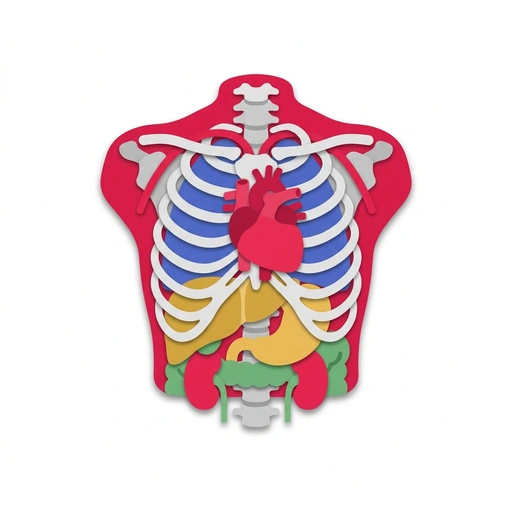
The Architecture of the Human Body
Understand how the human body really fits together, from bony landmarks and force-transmitting joints to visceral compartments and neurovascular routes.
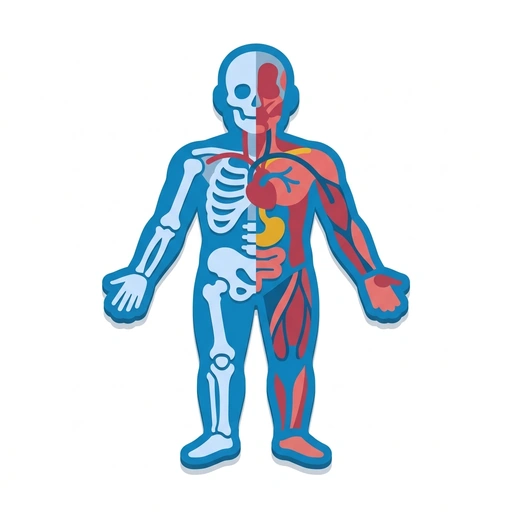
Human Anatomy: Form and Function
Bridge the gap between basic body parts and true functional anatomy. Discover how bones, muscles, nerves, and organs mechanically coordinate to sustain motion, regulate pressure, and maintain life.
Functional Human Anatomy
Bridge the gap between anatomical names and how the living body actually moves. Discover how bones, joints, muscles, and neural circuits collaborate to generate force and control motion.
Applied Human Anatomy
Bridge the gap between textbook organ lists and real human function. Learn how fascial planes, neurovascular pathways, and visceral architecture shape the living body.
Applied Human Anatomy
Decode the architectural logic of the human body through topographical relationships, fascial planes, and systemic structural design. Move beyond simple memorization to understand how form governs function across every major system.
Functional Anatomy: Architecture of Motion
Look past static organ charts to understand how the human body balances force, fluid, and stability. Learn how joints glide, fascia routes tension, and body cavities generate hydraulic strength.
Start Functional Human Anatomy today.
Download Tomo, search Functional Human Anatomy, and play your first lesson in under a minute.