
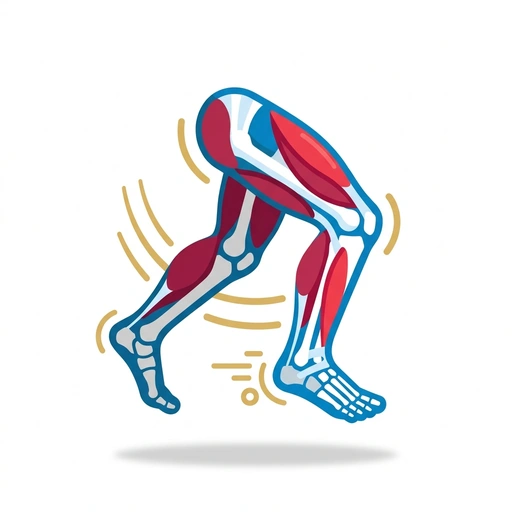
Functional Anatomy in Motion
Move beyond static muscle charts to understand how bones, joints, and myofascial systems coordinate real human movement. Learn how kinetic chains transfer force, why joint centration protects tissues, and how to spot subtle movement compensations in action.
Like Duolingo, but for Functional Anatomy in Motion. Tomo turns the whole topic into a game you play five minutes a day, until it actually sticks.
22 levels across 3 sections, about 44 minutes end to end, roughly 9 days at five minutes a day. It moves through Dynamic Mechanics in Action, Kinetic Chains and Force Transmission, and Tissue Architecture and Compensations. It assumes you already know the basics.
Free forever · No credit card · iPhone & Android
Key ideas in Functional Anatomy in Motion
- In sprinting, hamstrings act mostly to absorb energy and slow the swinging shin before touchdown.
- Eccentric braking protects joints by controlling limb momentum rather than simply creating forward drive.
- Muscles endure their highest dynamic forces while lengthening under load to brake motion.
- Reciprocal inhibition dials down opposing tone without fully silencing the antagonist muscle.
- Residual antagonist activity maintains joint centration and prevents sudden capsular traction.
- Complete antagonist shutoff would leave articular surfaces unstable at terminal ranges.
- Closed-chain actions fix the distal segment, causing muscle pull to move the proximal skeleton.
- Open-chain motions move the distal limb while the proximal trunk remains the stable anchor.
- Anatomical origin and insertion swap practical roles when distal contact bears bodyweight.
- Core musculature stiffens isometrically milliseconds before prime movers accelerate distal limbs.
- Proximal stiffness creates an unyielding anchor that prevents energy bleed and lumbar shear.
- Distal extremity velocity depends directly on how rigidly the proximal core is braced first.
- A muscle's moment arm changes continuously as the tendon's line of pull shifts relative to the joint axis.
- The biceps brachii achieves its greatest mechanical leverage perpendicular to the forearm around 90 degrees.
- At full extension, tendon pull runs parallel to bone, directing force toward joint compression rather than torque.
- A force couple consists of parallel forces acting in opposite directions at equal distance from an axis.
You've tried the other tabs
Thirty open tabs. Four facts you actually kept.
You watched. You nodded. By Sunday it was gone.
One answer, then back to scrolling.
Eight weeks. You meant to finish. You didn't.
Tomo gives Functional Anatomy in Motion the Duolingo treatment: levels, streaks, and quick quizzes that test what you just learned. That game loop is what the tabs above never had, so it's the one you actually finish.
Here's what playing it feels like
A real question from this course. Take your best guess.
How does eccentric braking primarily safeguard your joints during dynamic movements?
Get it right to open this lesson and 21 more in the app.
Where Functional Anatomy in Motion takes you
- 1
Dynamic Mechanics in Action
- Functional Muscle Actions Beyond Origin and Insertion
- Force Couples and Joint Centration
- 2
Kinetic Chains and Force Transmission
- The Lower Extremity Kinetic Chain
- The Core as a Force Conduit
- Scapulohumeral Rhythm and Upper Limb Dynamics
- 3
Tissue Architecture and Compensations
- Fascial Elasticity and Passive Load Transfer
- Detecting Movement Compensations
3 sections · 7 units · 22 levels. Built to play, not to enroll.
Tomo is in ChatGPT
Tomo is also a ChatGPT plugin: the same playable courses, built and played inside your chat.
Add Tomo to ChatGPT- What to ask
- “Make me a Tomo course on black holes.” “Turn this chat into a Tomo course.”
- What you get
- Quick questions with instant feedback, hearts and stars, ready to play in about a minute.
- Where it goes
- No sign-up to start. Connect your Tomo account and your streak carries on in the app.
You pick the voice
Functional Anatomy in Motion is taught in the Professor style: clear, structured, thorough. Want a different feel? In the app you can spin up the same topic in any of Tomo's teaching styles. Same facts, totally different vibe.
More Health on Tomo
Musculoskeletal Anatomy in Motion
Bridge the gap between memorizing bone names and understanding how the living body generates force and stabilizes joints. Explore the mechanical levers, dynamic force couples, and tissue adaptations that govern human movement and physical resilience.
Pilates Biomechanics and Anatomy
Understand the musculoskeletal machinery and physiological reflexes that power Pilates. Learn how joint mechanics, myofascial slings, and spring physics transform classic exercises from rote choreography into targeted physical conditioning.
Anatomy for Pilates Movement
Bridge the gap between textbook anatomy and movement instruction. Understand joint mechanics, muscular lines of pull, and functional compensations across the classic and contemporary Pilates repertoire.
Pilates Anatomy in Motion
Look past generic cues and uncover the biomechanics behind every roll, reach, and teaser. Learn how deep stabilizers, myofascial slings, and joint mechanics work together to build effortless, injury-free movement.
Clinical Musculoskeletal Anatomy
Build a working knowledge of functional musculoskeletal anatomy for movement assessment and rehabilitation. Learn how muscle lines of pull, force couples, and kinetic chains drive human motion and clinical decision-making.
Anatomy for Pilates Professionals
Bridge the gap between textbook anatomy and the moving body. Master the musculoskeletal relationships that drive core stability, spinal articulation, and efficient movement patterns in your clients.
Start Functional Anatomy in Motion today.
Download Tomo, search Functional Anatomy in Motion, and play your first lesson in under a minute.