
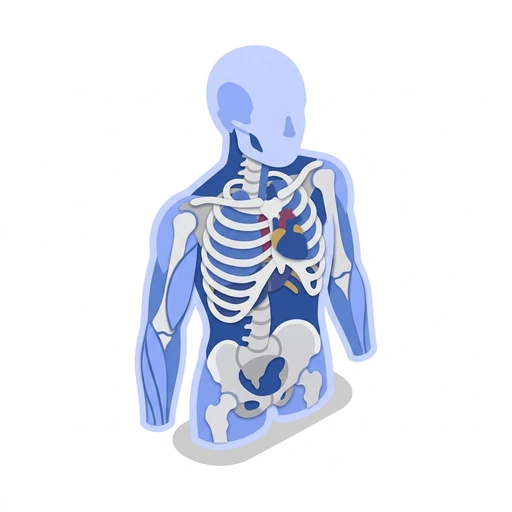
Mapping the Human Body
Discover how your body fits together and functions as an integrated living structure. Learn to trace your skeletal landmarks, understand muscle mechanics, and see how vital internal systems keep you alive.
Like Duolingo, but for Mapping the Human Body. Tomo turns the whole topic into a game you play five minutes a day, until it actually sticks.
A short one: 12 levels across 2 sections, about 24 minutes end to end, roughly 5 days at five minutes a day. It moves through The Moving Architecture and The Internal Life Support. It starts from scratch.
Free forever · No credit card · iPhone & Android
Key ideas in Mapping the Human Body
- Bony landmarks are spots where bone sits directly against subcutaneous tissue without thick muscle covering it
- The clavicle (collarbone), iliac crest (hip ridge), and olecranon (elbow tip) are easily palpated on almost every body type
- Deep bones like the shaft of the femur or anterior vertebral bodies are buried beneath thick layers of muscle and tissue
- Bone is living tissue that constantly breaks down and rebuilds throughout adult life
- Mechanical stress, such as lifting weights or bearing impact, stimulates bone to deposit new mineral and thicken along lines of force
- Prolonged inactivity or weightlessness causes bone tissue to resorb and weaken
- The axial skeleton forms the central axis of the body—the skull, spine, and ribs—primarily shielding soft organs like the brain, heart, and lungs
- The appendicular skeleton comprises the limbs and their supporting girdles (shoulders and pelvis), built primarily for moving through space
- The pelvis and shoulder girdles anchor the appendages rather than forming part of the central protective axis
- Joint architecture balances stability against range of motion
- A deep ball-and-socket joint like the hip provides high stability and weight-bearing strength at the cost of restricted movement
- A shallow socket like the shoulder allows massive circular mobility in multiple planes but is much easier to displace
- Healthy articular cartilage contains no direct blood vessels or capillaries
- Nutrients and waste move into cartilage by diffusion from synovial fluid
- Rhythmic joint compression and release acts like a mechanical pump, circulating fluid and nutrients into the dense tissue
- Muscle fibers only generate force in one direction by contracting and pulling; they cannot actively push
You've tried the other tabs
Thirty open tabs. Four facts you actually kept.
You watched. You nodded. By Sunday it was gone.
One answer, then back to scrolling.
Eight weeks. You meant to finish. You didn't.
Tomo gives Mapping the Human Body the Duolingo treatment: levels, streaks, and quick quizzes that test what you just learned. That game loop is what the tabs above never had, so it's the one you actually finish.
Here's what playing it feels like
A real question from this course. Take your best guess.
Which of these points can you easily feel with your fingers on almost any body?
Get it right to open this lesson and 11 more in the app.
Where Mapping the Human Body takes you
- 1
The Moving Architecture
- Finding Your Skeletal Framework
- How Muscles Pull and Coordinate
- 2
The Internal Life Support
- Tracing Blood and Breath Delivery
- How Organs Process and Cleanse Fuel
2 sections · 4 units · 12 levels. Built to play, not to enroll.
Tomo is in ChatGPT
Tomo is also a ChatGPT plugin: the same playable courses, built and played inside your chat.
Add Tomo to ChatGPT- What to ask
- “Make me a Tomo course on black holes.” “Turn this chat into a Tomo course.”
- What you get
- Quick questions with instant feedback, hearts and stars, ready to play in about a minute.
- Where it goes
- No sign-up to start. Connect your Tomo account and your streak carries on in the app.
You pick the voice
Mapping the Human Body is taught in the Professor style: clear, structured, thorough. Want a different feel? In the app you can spin up the same topic in any of Tomo's teaching styles. Same facts, totally different vibe.
More Science on Tomo
How the Human Body Fits Together
Explore the elegant architecture of your own body from the inside out. Learn how your skeleton, muscles, circulation, and vital organs coordinate to keep you upright, moving, and alive.
Mapping the Human Body
Learn to read your own physical structure using accessible bony landmarks and mechanical principles. Understand how bones, muscles, internal cavities, and vital vessels fit together into a coordinated architectural system.
Anatomy of the Human Body
Discover how your bones, muscles, and internal systems coordinate every breath and step. Understand the physical machinery that powers daily movement, circulation, and sensation.
How the Human Body Is Built
Discover the physical architecture that keeps you moving, breathing, and alive. From the mechanical levers of your skeleton to the internal plumbing of your organs, learn to read the map of your own body with clarity and confidence.
Mapping the Human Body
Discover how the living human body is built, organized, and engineered to function. Learn to read anatomical landmarks, understand how joints and muscles generate motion, and trace how internal organs coordinate life beneath your skin.
How the Human Body Works
Discover the mechanical and chemical systems that keep you alive, moving, and balanced every day. Learn how your organs coordinate under stress, how muscles pull to create motion, and how the body quietly resets itself behind the scenes.
Start Mapping the Human Body today.
Download Tomo, search Mapping the Human Body, and play your first lesson in under a minute.