
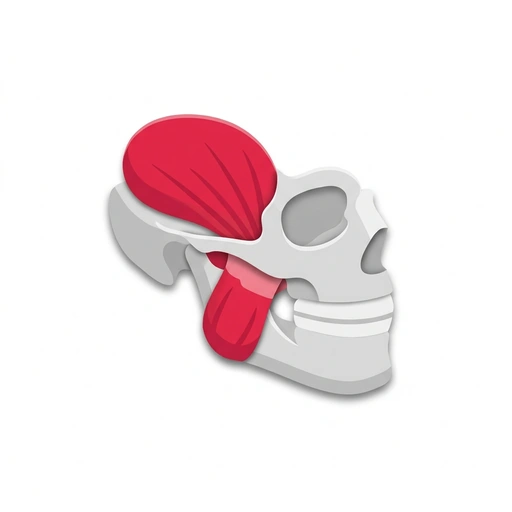
Muscles of Mastication
Build a rigorous, exam-ready grasp of the primary and accessory muscles that control jaw movement. Master their origin and insertion landmarks, biomechanical force vectors, and the cranial nerve pathways that drive clinical presentations. From lateral excursion dynamics to TMJ derangements and nerve lesion deviations, learn how each anatomical relationship appears on practical exams.
Like Duolingo, but for Muscles of Mastication. Tomo turns the whole topic into a game you play five minutes a day, until it actually sticks.
26 levels across 3 sections, about 52 minutes end to end, roughly 10 days at five minutes a day. It moves through Predicting Mandibular Movement, Dissecting Muscle Architecture, and Tracing Innervation and Clinical Lesions. It assumes you already know the basics.
Free forever · No credit card · iPhone & Android
Key ideas in Muscles of Mastication
- Mandibular kinematics resolve along three orthogonal anatomical axes
- Elevation lifts the jaw closed while depression pulls it open against resistance
- Protrusion glides the jaw forward while retrusion translates it back
- Three powerful muscles elevate the jaw: masseter, temporalis, and medial pterygoid
- Active jaw opening requires pulling the condyle forward via the inferior lateral pterygoid
- The suprahyoid muscle complex assists jaw depression by pulling the chin downward
- Masseter on the outside and medial pterygoid on the inside meet under the mandibular angle
- This anatomical sling cradles the mandible to produce powerful vertical molar bite forces
- Their shared insertion suspends the jaw angle between dual upward vectors
- Symmetrical protrusion demands simultaneous, bilateral lateral pterygoid activation
- Condyles and articular discs glide forward and downward along the articular eminence
- Unilateral contraction would produce contralateral excursion rather than true forward protrusion
- Retrusion pulls the condylar head backward from the eminence into the glenoid fossa
- The temporalis has distinct fiber vectors: anterior fibers lift vertically, posterior fibers pull horizontally
- Posterior horizontal temporalis fibers are the primary motor drivers of jaw retrusion
- The contralateral pterygoids fire to pull that condyle forward and push the chin across the midline.
You've tried the other tabs
Thirty open tabs. Four facts you actually kept.
You watched. You nodded. By Sunday it was gone.
One answer, then back to scrolling.
Eight weeks. You meant to finish. You didn't.
Tomo gives Muscles of Mastication the Duolingo treatment: levels, streaks, and quick quizzes that test what you just learned. That game loop is what the tabs above never had, so it's the one you actually finish.
Here's what playing it feels like
A real question from this course. Take your best guess.
Picture biting into a crisp apple: which motion pairs closing the jaw with pulling it open?
Get it right to open this lesson and 25 more in the app.
Where Muscles of Mastication takes you
- 1
Predicting Mandibular Movement
- Mapping Jaw Vectors to Muscle Actions
- Unilateral and Bilateral Excursion Mechanics
- 2
Dissecting Muscle Architecture
- The Powerful Closers: Temporalis and Masseter
- The Pterygoids: Deep Sling and Joint Stabilizers
- Accessory Muscles and the Masticatory Unit
- 3
Tracing Innervation and Clinical Lesions
- CN V3 Routing and Motor Distribution
- Diagnosing Nerve Lesions and Mandibular Deviation
- TMJ Biomechanics and Masticatory Pathologies
3 sections · 8 units · 26 levels. Built to play, not to enroll.
Tomo is in ChatGPT
Tomo is also a ChatGPT plugin: the same playable courses, built and played inside your chat.
Add Tomo to ChatGPT- What to ask
- “Make me a Tomo course on black holes.” “Turn this chat into a Tomo course.”
- What you get
- Quick questions with instant feedback, hearts and stars, ready to play in about a minute.
- Where it goes
- No sign-up to start. Connect your Tomo account and your streak carries on in the app.
You pick the voice
Muscles of Mastication is taught in the Storyteller style: every lesson is a story. Want a different feel? In the app you can spin up the same topic in any of Tomo's teaching styles. Same facts, totally different vibe.
More Health on Tomo
Functional Anatomy for Occupational Therapy
Learn the mechanical and neurological systems that drive human movement, positioning, and task performance. Connect joint mechanics, nerve pathways, and postural stability directly to daily activities and functional independence. Master practical biomechanics to analyze movement limitations and design targeted physical interventions.
Functional Anatomy in Motion
Move beyond static muscle charts to understand how bones, joints, and myofascial systems coordinate real human movement. Learn how kinetic chains transfer force, why joint centration protects tissues, and how to spot subtle movement compensations in action.
Mapping Dermatomes and Myotomes
Learn the body's hidden electrical blueprint. Decode numbness, tingling, and weakness by tracing nerve roots straight to the spine.
Clinical Anatomy in Motion
Discover how bones, muscles, and nerves coordinate to produce movement and withstand physical loads. Learn to spot mechanical stress points, understand common joint injuries, and see how the living body adapts to everyday forces.
Functional Anatomy for Physical Therapy
Understand how muscles, bones, nerves, and joints collaborate to produce healthy movement and recover from injury. Learn the essential anatomical structures and physiological healing principles that guide real-world rehabilitation exercises.
Functional Anatomy for Pilates
Bridge structural anatomy and practical movement analysis for Pilates instruction. Learn the origins, insertions, and coordinated actions of the major muscle groups that govern spinal articulation, pelvic stability, and full-body movement.
Start Muscles of Mastication today.
Download Tomo, search Muscles of Mastication, and play your first lesson in under a minute.