
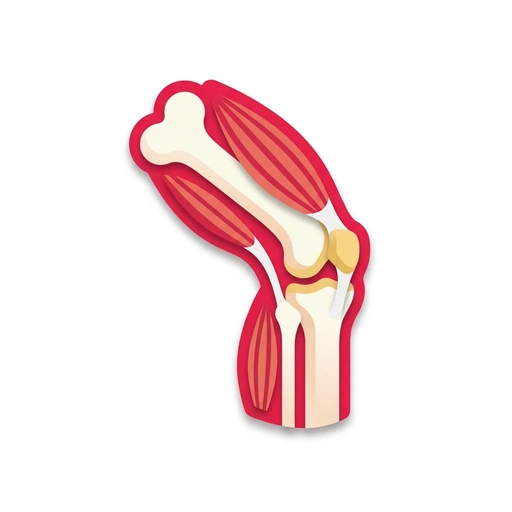
Musculoskeletal Anatomy: How Your Body Moves
Decode the bones, joints, and muscles that power every step, lift, and reach. Learn to trace anatomical landmarks on your own body and see how paired muscles act as living levers and pulleys.
Like Duolingo, but for Musculoskeletal Anatomy: How Your Body Moves. Tomo turns the whole topic into a game you play five minutes a day, until it actually sticks.
A short one: 11 levels across 2 sections, about 22 minutes end to end, roughly 4 days at five minutes a day. It moves through Mapping the Upper Chassis and The Lower Body Engine. It starts from scratch.
Free forever · No credit card · iPhone & Android
Key ideas in Musculoskeletal Anatomy: How Your Body Moves
- Bony landmarks are hard skeletal edges or bumps that sit directly under the skin without thick muscle covering them
- Soft, squishy tissues like muscle bellies or fat pads are not bony landmarks
- Palpable landmarks like the elbow tip (olecranon), kneecap (patella), and hip crest give surface roadmaps for where muscle bellies begin and end
- Hinge joints (like the elbow or knee) restrict motion strictly along one plane, gaining stability from tight interlocking bone shapes
- Ball-and-socket joints (like the shoulder or hip) allow multi-directional rotation across multiple planes
- Ball-and-socket joints gain freedom of motion by sacrificing the tight bony interlocking that stabilizes hinge joints
- Tendons connect muscle tissue to bone, acting as durable cables that transfer muscle contraction into skeletal movement
- Ligaments connect bone to bone across a joint, acting like tough straps that prevent bones from pulling apart or dislocating
- Muscles pull through tendons; ligaments do not contract to generate pulling force
- The collarbone (clavicle) is the only bony strut connecting the entire arm and shoulder assembly to the central skeleton at the breastbone
- The shoulder blade (scapula) does not form a true bony joint with the ribs; it floats across the rib cage suspended and guided purely by layers of muscle
- This floating muscular design allows the shoulder blade enormous freedom to glide, tilt, and rotate around the torso
- Muscle fibers can only actively shorten and pull; they cannot push
- Straightening a bent joint requires an opposing muscle on the other side (like the triceps) to contract and pull in the opposite direction
- The pectorals attach across the chest and pull the upper arm forward and inward (like in a hug or push-up)
- The latissimus dorsi spans the back and pulls the upper arm downward and backward (like in a pull-up or row)
You've tried the other tabs
Thirty open tabs. Four facts you actually kept.
You watched. You nodded. By Sunday it was gone.
One answer, then back to scrolling.
Eight weeks. You meant to finish. You didn't.
Tomo gives Musculoskeletal Anatomy: How Your Body Moves the Duolingo treatment: levels, streaks, and quick quizzes that test what you just learned. That game loop is what the tabs above never had, so it's the one you actually finish.
Here's what playing it feels like
A real question from this course. Take your best guess.
When you want to map your skeleton, which of these is NOT a bony landmark?
Get it right to open this lesson and 10 more in the app.
How to learn Musculoskeletal Anatomy: How Your Body Moves, step by step
Go in order. 11 short levels across 2 sections, about 22 minutes in all, five minutes a day.
- 1
Mapping the Upper Chassis
- Finding Your Bony Landmarks
- The Upper Body Pulley System
- 2
The Lower Body Engine
- Pelvis, Core, and the Hip Hinge
- Legs, Knees, and Spring Mechanics
2 sections · 4 units · 11 levels. Built to play, not to enroll.
Questions about Musculoskeletal Anatomy: How Your Body Moves
How do I learn Musculoskeletal Anatomy: How Your Body Moves?
Go in order: start with Mapping the Upper Chassis, then The Lower Body Engine. On Tomo that's 11 short levels, about 22 minutes in all, played five minutes a day. Start free and play the first level in under a minute.
Is there a Duolingo-style app for Musculoskeletal Anatomy: How Your Body Moves?
Yes. Tomo works like Duolingo: short daily lessons, streaks and quick quizzes. Musculoskeletal Anatomy: How Your Body Moves is one of its free courses, and you can type any other topic to get a course of your own.
Is the Musculoskeletal Anatomy: How Your Body Moves course free?
Yes. Musculoskeletal Anatomy: How Your Body Moves is playable on Tomo's free plan, which doesn't expire. No credit card, no waitlist. Download the app and start your first lesson.
How long does it take to learn Musculoskeletal Anatomy: How Your Body Moves?
11 levels across 2 sections, about 22 minutes of play in total. It's built for five minutes a day, so you finish it a little at a time instead of all at once.
Do I need any background to start Musculoskeletal Anatomy: How Your Body Moves?
No. It's pitched at a beginner level, so it starts where you are and builds up. If you can tap a phone, you can start.
Tomo is in ChatGPT
Tomo is also a ChatGPT plugin: the same playable courses, built and played inside your chat.
Add Tomo to ChatGPT- What to ask
- “Make me a Tomo course on black holes.” “Turn this chat into a Tomo course.”
- What you get
- Quick questions with instant feedback, hearts and stars, ready to play in about a minute.
- Where it goes
- No sign-up to start. Connect your Tomo account and your streak carries on in the app.
You pick the voice
Musculoskeletal Anatomy: How Your Body Moves is taught in the Bestie style: your friend who just gets it. Want a different feel? In the app you can spin up the same topic in any of Tomo's teaching styles. Same facts, totally different vibe.
More Science on Tomo
Mapping Your Own Body
Learn basic human anatomy by reading the physical landmarks, levers, and cavities of your own living frame. Discover how bones act as structural bridges, why muscles work strictly in pulling pairs, and where your vital organs actually sit.
Human Muscle Anatomy
Discover how facial expressions, posture, and athletic movements actually work from the inside out. Learn the major muscle groups of the human body and the physiological mechanics behind every motion.
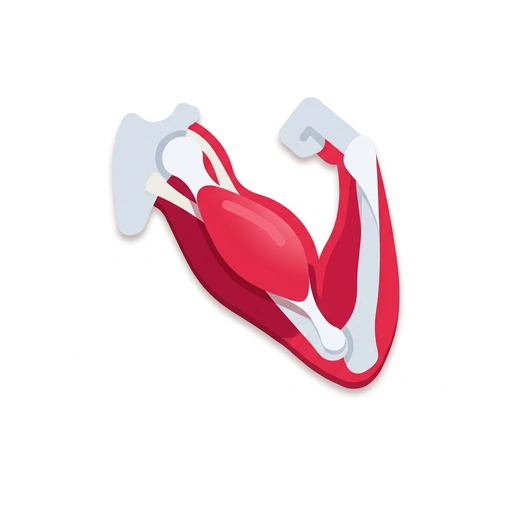
Decoding Human Muscle Names
Stop memorizing muscle names as arbitrary Latin jargon. Discover the simple visual code of shapes, sizes, and attachment points that makes anatomical names instantly make sense.

Bones of the Face and Body
Discover the names, shapes, and hidden engineering of the human skeleton. Learn to identify the bones across your face, limbs, and core, and see how they protect your organs and power everyday movement.
Mapping the Human Body
Discover how the living human body is built, organized, and engineered to function. Learn to read anatomical landmarks, understand how joints and muscles generate motion, and trace how internal organs coordinate life beneath your skin.
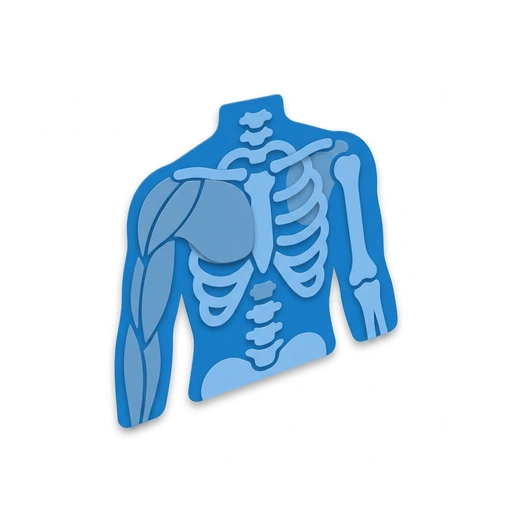
Mapping the Human Body
Learn to read your own physical structure using accessible bony landmarks and mechanical principles. Understand how bones, muscles, internal cavities, and vital vessels fit together into a coordinated architectural system.
Start Musculoskeletal Anatomy: How Your Body Moves today.
Download Tomo, search Musculoskeletal Anatomy: How Your Body Moves, and play your first lesson in under a minute.