
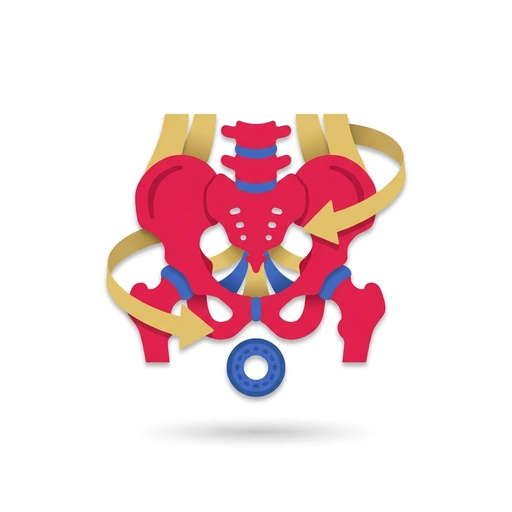
The Pilates Pelvic Floor
Bridge the gap between anatomy diagrams and real movement cues. Learn how the pelvic floor anchors the powerhouse, responds to breath, and transforms classic Pilates repertoire on the mat and reformer.
Like Duolingo, but for The Pilates Pelvic Floor. Tomo turns the whole topic into a game you play five minutes a day, until it actually sticks.
A short one: 12 levels across 2 sections, about 24 minutes end to end, roughly 5 days at five minutes a day. It moves through The Dynamic Base: Bones, Breath, and Tone and From Anatomy to the Mat and Reformer. It starts from scratch.
Free forever · No credit card · iPhone & Android

Key ideas in The Pilates Pelvic Floor
- The pelvic floor suspends between four distinct bony borders
- The pubic bone acts as the anterior boundary and the tailbone (coccyx) as the posterior boundary
- The two ischial tuberosities (sit bones) form the side corners of the diamond
- The pelvic floor acts as a deep, subtle hammock, not a powerful surface clencher
- Gripping the glutes masks true deep pelvic floor recruitment and tilts the pelvis
- Effective activation feels like drawing the four bony corners toward one another without squeezing the buttocks
- Deep hip flexion naturally causes the sit bones to spread apart and widen the base
- Extending the hips back to upright brings the sit bones subtly back toward one another
- Attempting to pinch the sit bones together while bending the hips fights natural pelvic mechanics
- Neutral pelvis allows the pelvic floor to rest at its optimal resting length, capable of both yielding and contracting
- A tucked or tilted pelvis holds the muscles either chronically shortened or strained taut, reducing functional support
- The anterior hip points (ASIS) and the pubic bone form a flat triangular plane parallel to the floor when supine
- If the pubic bone is higher than the hip bones, the pelvis is tucked; if lower, the lower back is excessively arched
- On an inhale, the diaphragm drops down and the pelvic floor relaxes downward to accommodate it
- On an exhale, the diaphragm domes upward and the pelvic floor naturally lifts alongside it
- Gripping the abdominal wall tightly locks the breath piston in place
You've tried the other tabs
Thirty open tabs. Four facts you actually kept.
You watched. You nodded. By Sunday it was gone.
One answer, then back to scrolling.
Eight weeks. You meant to finish. You didn't.
Tomo gives The Pilates Pelvic Floor the Duolingo treatment: levels, streaks, and quick quizzes that test what you just learned. That game loop is what the tabs above never had, so it's the one you actually finish.
Here's what playing it feels like
A real question from this course. Take your best guess.
Which bones mark the front and back borders of the pelvic floor?
Get it right to open this lesson and 11 more in the app.
Where The Pilates Pelvic Floor takes you
- 1
The Dynamic Base: Bones, Breath, and Tone
- Mapping the Bony Diamond
- The Breath Piston: Diaphragm and Floor
- 2
From Anatomy to the Mat and Reformer
- Layer Mechanics and Smarter Cuing
- The Pelvic Floor in Classic Repertoire
2 sections · 4 units · 12 levels. Built to play, not to enroll.
You pick the voice
The Pilates Pelvic Floor is taught in the The Bestie style: your friend who just gets it. Want a different feel? In the app you can spin up the same topic in any of Tomo's teaching styles. Same facts, totally different vibe.
More Health on Tomo

Pelvic Floor Health in Pilates
Elevate your Pilates teaching by mastering pelvic floor biomechanics, breath dynamics, and intra-abdominal pressure regulation. Learn to identify hypertonic and hypotonic patterns, replace counterproductive cues, and adapt mat and reformer repertoire safely for real-world clients.
Reformer Pilates Anatomy and Alignment
Learn the essential biomechanics, cueing principles, and joint safety rules needed for Reformer Pilates. Master pelvic alignment, core activation, and exercise modifications for special populations.
Anatomy for Pilates
Understand the muscles, joints, and mechanics behind every Pilates movement. Learn how your core, spine, and breath work together to build balanced strength and prevent strain.
Anatomy for Pilates Movement
Understand the functional anatomy behind classic Pilates exercises and cues. Learn how the deep core, spine, and joint stabilizers work together to guide safe, effective movement.
Mat Pilates: Movement and Anatomy
Discover the anatomical logic and precise movements of classical mat Pilates. Learn how to activate your powerhouse, articulate your spine, and build lasting core stability from the floor up.
Pilates Anatomy in Motion
Look past generic cues and uncover the biomechanics behind every roll, reach, and teaser. Learn how deep stabilizers, myofascial slings, and joint mechanics work together to build effortless, injury-free movement.
Start The Pilates Pelvic Floor today.
Download Tomo, search The Pilates Pelvic Floor, and play your first lesson in under a minute.