
Functional Anatomy in Motion
Bridge the gap between static textbook diagrams and the dynamic, living human body. Learn how bones, joints, fascia, and nerves interlock to generate movement, distribute load, and refer pain.
Like Duolingo, but for Functional Anatomy in Motion. Tomo turns the whole topic into a game you play five minutes a day, until it actually sticks.
A short one: 11 levels across 2 sections, about 22 minutes end to end, roughly 4 days at five minutes a day. It moves through Mapping Mechanics from the Surface and Internal Pathways and Force Transmission. It assumes you already know the basics.
Free forever · No credit card · iPhone & Android

Key ideas in Functional Anatomy in Motion
- Skeletal landmarks stay geometrically constant relative to deep neurovascular structures during movement.
- Skin folds and adipose pads slide substantially over deep fascia as posture changes.
- Palpable bony prominences provide unshifting coordinates for safe needle trajectories.
- Arterial pulses require a rigid bony shelf behind the vessel to generate palpable wall expansion.
- Compressing an artery into compliant muscle bellies dissipates the systolic pressure wave.
- The distal radius provides the firm flat backstop needed to feel radial pulse pulsations.
- The palpable ridge of the sternal angle lies just below the manubrium.
- The second costal cartilage articulates directly with the lateral edge of the sternal angle.
- The second intercostal space lies immediately inferior to the palpated second rib.
- A prime mover's tendon develops high tension and stands out prominently during active contraction.
- An antagonist reciprocally inhibits tension, leaving its tendon comparatively soft and slack.
- Synergist tendons firm up selectively to cancel unintended multi-axis movement.
- Articular congruency provides inherent passive stability without consuming metabolic energy.
- Dynamic stabilizers continuously contract to seat a mobile bone head centrally in its socket.
- Joint capsules provide passive tensile restraint only when stretched near terminal range.
- Ligaments remain relatively lax throughout mid-range joint excursion to permit free motion.
You've tried the other tabs
Thirty open tabs. Four facts you actually kept.
You watched. You nodded. By Sunday it was gone.
One answer, then back to scrolling.
Eight weeks. You meant to finish. You didn't.
Tomo gives Functional Anatomy in Motion the Duolingo treatment: levels, streaks, and quick quizzes that test what you just learned. That game loop is what the tabs above never had, so it's the one you actually finish.
Here's what playing it feels like
A real question from this course. Take your best guess.
What happens to surface skin folds and fat pads when a person changes posture?
Get it right to open this lesson and 10 more in the app.
How to learn Functional Anatomy in Motion, step by step
Go in order. 11 short levels across 2 sections, about 22 minutes in all, five minutes a day.
- 1
Mapping Mechanics from the Surface
- Mapping Core Surface Landmarks
- Joint Stability Under Load
- 2
Internal Pathways and Force Transmission
- Fascial Planes and Force Chains
- Neurovascular Highways and Referred Signals
2 sections · 4 units · 11 levels. Built to play, not to enroll.
Questions about Functional Anatomy in Motion
How do I learn Functional Anatomy in Motion?
Go in order: start with Mapping Mechanics from the Surface, then Internal Pathways and Force Transmission. On Tomo that's 11 short levels, about 22 minutes in all, played five minutes a day. Start free and play the first level in under a minute.
Is there a Duolingo-style app for Functional Anatomy in Motion?
Yes. Tomo works like Duolingo: short daily lessons, streaks and quick quizzes. Functional Anatomy in Motion is one of its free courses, and you can type any other topic to get a course of your own.
Is the Functional Anatomy in Motion course free?
Yes. Functional Anatomy in Motion is playable on Tomo's free plan, which doesn't expire. No credit card, no waitlist. Download the app and start your first lesson.
How long does it take to learn Functional Anatomy in Motion?
11 levels across 2 sections, about 22 minutes of play in total. It's built for five minutes a day, so you finish it a little at a time instead of all at once.
Do I need any background to start Functional Anatomy in Motion?
No. It's pitched at an intermediate level, so it starts where you are and builds up. If you can tap a phone, you can start.
Tomo is in ChatGPT
Tomo is also a ChatGPT plugin: the same playable courses, built and played inside your chat.
Add Tomo to ChatGPT- What to ask
- “Make me a Tomo course on black holes.” “Turn this chat into a Tomo course.”
- What you get
- Quick questions with instant feedback, hearts and stars, ready to play in about a minute.
- Where it goes
- No sign-up to start. Connect your Tomo account and your streak carries on in the app.
You pick the voice
Functional Anatomy in Motion is taught in the Professor style: clear, structured, thorough. Want a different feel? In the app you can spin up the same topic in any of Tomo's teaching styles. Same facts, totally different vibe.
More Science on Tomo

Reading Human Anatomy
Move beyond isolated muscle names to understand how the body organizes space, transfers force, and routes vital plumbing. Learn to navigate the living blueprint using landmarks, compartments, and kinetic chains.
Functional Human Anatomy
Understand how the human body balances mobility, stability, and internal pressure during movement. Learn why joint pain often originates several segments away, how fascial sheets distribute kinetic load, and how anatomical bottlenecks protect critical nerves and vessels.
Human Anatomy: Form and Function
Bridge the gap between basic body parts and true functional anatomy. Discover how bones, muscles, nerves, and organs mechanically coordinate to sustain motion, regulate pressure, and maintain life.
The Architecture of the Human Body
Understand how the human body really fits together, from bony landmarks and force-transmitting joints to visceral compartments and neurovascular routes.
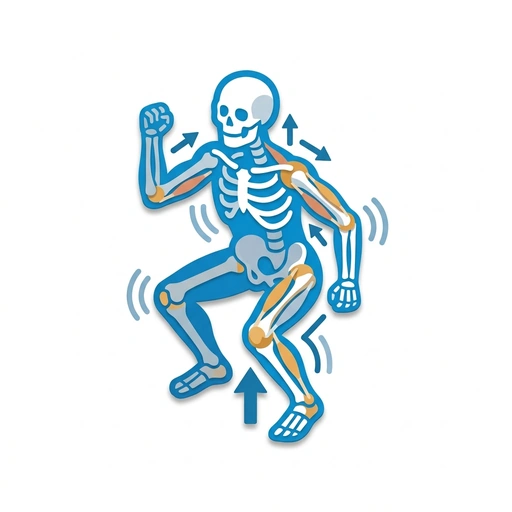
Functional Anatomy: How the Body Handles Force
Move past rote memorization of muscle names and discover the biomechanical architecture of the human body. Learn how moment arms, two-joint muscle dynamics, core hydraulics, and elastic fascia manage force and movement.
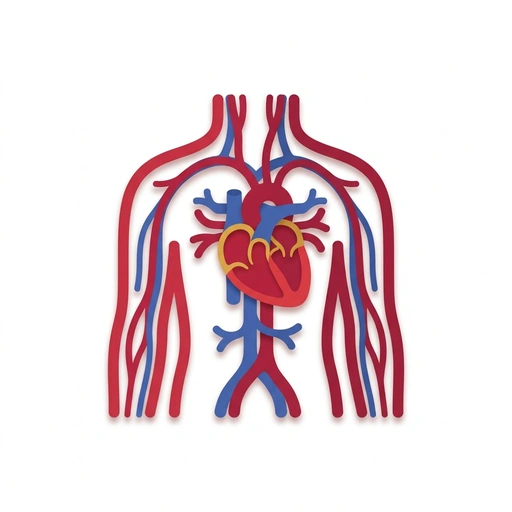
How the Body Fits Together
Move beyond isolated memorization to understand the structural logic, mechanical levers, and pressurized systems of human anatomy. Discover how bones, muscles, nerves, and organs work as interconnected architectural units in a living body.
Start Functional Anatomy in Motion today.
Download Tomo, search Functional Anatomy in Motion, and play your first lesson in under a minute.