
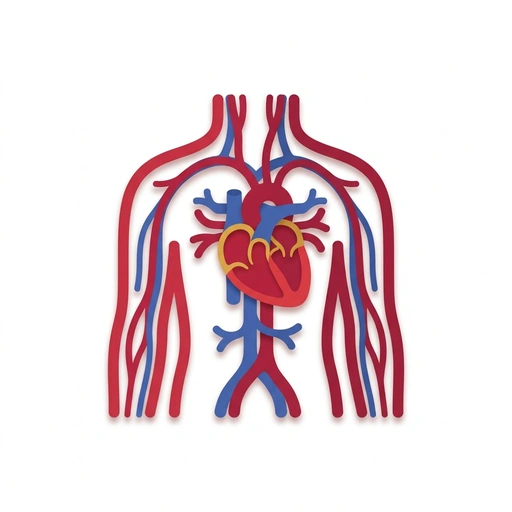
How the Body Fits Together
Move beyond isolated memorization to understand the structural logic, mechanical levers, and pressurized systems of human anatomy. Discover how bones, muscles, nerves, and organs work as interconnected architectural units in a living body.
Like Duolingo, but for How the Body Fits Together. Tomo turns the whole topic into a game you play five minutes a day, until it actually sticks.
24 levels across 3 sections, about 48 minutes end to end, roughly 10 days at five minutes a day. It moves through Navigating Framework and Movement, Internal Chambers and Fluid Pathways, and Mechanical Limits and Architectural Tradeoffs. It assumes you already know the basics.
Free forever · No credit card · iPhone & Android
Key ideas in How the Body Fits Together
- Bony prominences stay fixed under skin and muscle, providing reliable reference points across posture changes.
- The horizontal sternal angle aligns directly with the second costal cartilage to count ribs accurately.
- The iliac crest marks the L4 vertebra level to ensure safe access below the spinal cord during a spinal tap.
- Forward-and-backward swinging motions like hip flexion take place parallel to the sagittal plane.
- Side-to-side movements like arm abduction occur within the frontal (coronal) plane.
- Anatomical reference planes describe slices of active movement rather than frozen upright positions.
- Arterial pulses require firm bony support underneath so fingertip pressure can arrest and sense the pressure wave.
- The radial pulse is palpated by pressing the radial artery directly against the flat distal radius.
- The carotid artery is palpated against the anterior tubercle of the sixth cervical vertebra (Chassaignac tubercle).
- Surface projection lines map deep organs onto palpable chest and abdominal landmarks.
- The right midclavicular line runs vertically downward from the center of the clavicle.
- The normal superior border of the liver rises to the level of the right fifth intercostal space beneath the diaphragm.
- Directional anatomical terms are anchored to the standard upright anatomical position, never the patient's immediate posture.
- Anterior always refers to the front of the body regardless of whether a person lies prone, supine, or inverted.
- Superior always denotes a position closer to the head end along the axis of the anatomical position.
- In third-class levers, the muscle effort inserts between the fulcrum and the load
You've tried the other tabs
Thirty open tabs. Four facts you actually kept.
You watched. You nodded. By Sunday it was gone.
One answer, then back to scrolling.
Eight weeks. You meant to finish. You didn't.
Tomo gives How the Body Fits Together the Duolingo treatment: levels, streaks, and quick quizzes that test what you just learned. That game loop is what the tabs above never had, so it's the one you actually finish.
Here's what playing it feels like
A real question from this course. Take your best guess.
Why is the sternal angle such a critical landmark on the chest?
Get it right to open this lesson and 23 more in the app.
Where How the Body Fits Together takes you
- 1
Navigating Framework and Movement
- Surface Landmarks and Palpable Waypoints
- Joint Geometry and Skeletal Lever Systems
- Fascial Architecture and Compartmental Logic
- 2
Internal Chambers and Fluid Pathways
- Thoracoabdominal Cavities and Pressure Dynamics
- Neurovascular Highways and Circulatory Circuits
- Visceral Packaging and Peritoneal Mapping
- 3
Mechanical Limits and Architectural Tradeoffs
- Structural Bottlenecks and Entrapment Zones
- Evolutionary Compromises of the Upright Body
3 sections · 8 units · 24 levels. Built to play, not to enroll.
Tomo is in ChatGPT
Tomo is also a ChatGPT plugin: the same playable courses, built and played inside your chat.
Add Tomo to ChatGPT- What to ask
- “Make me a Tomo course on black holes.” “Turn this chat into a Tomo course.”
- What you get
- Quick questions with instant feedback, hearts and stars, ready to play in about a minute.
- Where it goes
- No sign-up to start. Connect your Tomo account and your streak carries on in the app.
You pick the voice
How the Body Fits Together is taught in the Professor style: clear, structured, thorough. Want a different feel? In the app you can spin up the same topic in any of Tomo's teaching styles. Same facts, totally different vibe.
More Science on Tomo
Reading Human Anatomy
Move beyond isolated muscle names to understand how the body organizes space, transfers force, and routes vital plumbing. Learn to navigate the living blueprint using landmarks, compartments, and kinetic chains.
How the Human Body Fits Together
Move beyond memorizing isolated bones and organs to understand how your body is engineered. Learn the mechanical tradeoffs, vascular highways, and pressure chambers that keep everything working.
Applied Human Anatomy
Bridge the gap between textbook organ lists and real human function. Learn how fascial planes, neurovascular pathways, and visceral architecture shape the living body.
The Architecture of the Human Body
Understand how the human body really fits together, from bony landmarks and force-transmitting joints to visceral compartments and neurovascular routes.
How the Human Body Fits Together
Understand your body's structural architecture through the bones, muscles, and organs you live with every day. Map where parts actually sit and see how your internal systems coordinate every breath and step.
Mapping the Human Body
Learn to read your own physical structure using accessible bony landmarks and mechanical principles. Understand how bones, muscles, internal cavities, and vital vessels fit together into a coordinated architectural system.
Start How the Body Fits Together today.
Download Tomo, search How the Body Fits Together, and play your first lesson in under a minute.